





Bedroom pendant light: how many, where and what output
 By the Alméa team
9 min read
Sommaire
A well chosen bedroom pendant comes down to three answers: how many to hang, where to hang them and what output to give them. This guide gives you the figures for each case, from a small 9 m² bedroom to a bedroom with a pendant above the bed.
In a bedroom, you switch on the pendant to tidy up or get dressed, rarely to read. It needs to give good light without ever dazzling someone who is already lying down.
If you are looking to choose the style and material of a chandelier, our bedroom chandelier guide covers that. Here, we stick to the practical side: number, position, height, lumens.
Contents
- Do you really need a central pendant?
- How many pendants in a bedroom
- Where to place the bedroom pendant
- Above the bed: yes, on certain conditions
- At what height to hang it
- What output for a bedroom pendant
- Colour temperature and bulb
- What size of pendant to choose
- The pendant in a small bedroom
- Not being dazzled when lying down
- In short
- Frequently asked questions
1. Bedroom pendant light: do you really need a central light point?
Almost every bedroom has a light point in the ceiling, but you do not have to use it. Some people light their bedroom with wall lights and lamps only, an option we cover in detail in lighting a bedroom without a ceiling light.
The pendant remains useful as soon as the bedroom also serves as a dressing room or study: it gives general light at the flick of a switch. Ideally, plan it as part of a complete bedroom lighting plan, with bedside lights and ambient light.
2. How many pendants in a bedroom
In the vast majority of cases, a single pendant is enough.

| Layout | Number of pendants | Role |
|---|---|---|
| Bedroom of 9 to 14 m² | 1 on the ceiling | General light |
| Bedroom of 15 to 20 m² | 1 large one, or 1 plus a ceiling light by the wardrobe | General light and storage |
| Long master suite | 2, one per area (bed, seating area or desk) | Zoning the room |
| Hanging bedside lights | 2 small ones on either side of the bed, in addition to or instead of the central point | Reading and ambience |
For hanging bedside lights, which free up the bedside tables, see our guide to the bedside pendant.
3. Where to place the bedroom pendant
The geometric centre is not always the right spot, as the bed takes up a large part of the bedroom. Three positions work:
- In the centre of the free space, between the foot of the bed and the wardrobe: this is where you tidy up and get dressed. It is often the most useful position.
- At the foot of the bed, slightly offset: the light falls on the walkway, not on the pillows.
- Above the bed, centred on its width: the most decorative effect, with precautions (see below).
If the ceiling point is in an awkward place, a hook and an offset cable are enough to move the pendant: it is the offset chandelier technique.
4. Above the bed: yes, on certain conditions
A pendant above the bed creates an instant hotel-room feel. On four conditions:
- A light fitting, firmly fixed with a plug suited to the ceiling. Avoid heavy stone or thick glass models right above the pillows.
- At least 1 m between the mattress and the bottom of the light, so you can sit up in bed without bumping into it.
- A hidden source: a shade closed at the bottom, an opal diffuser or a tight woven fibre, so you cannot see the bulb when lying down.
- An offset towards the foot of the bed of 30 to 50 cm if possible, so the light falls on the duvet rather than on your face.
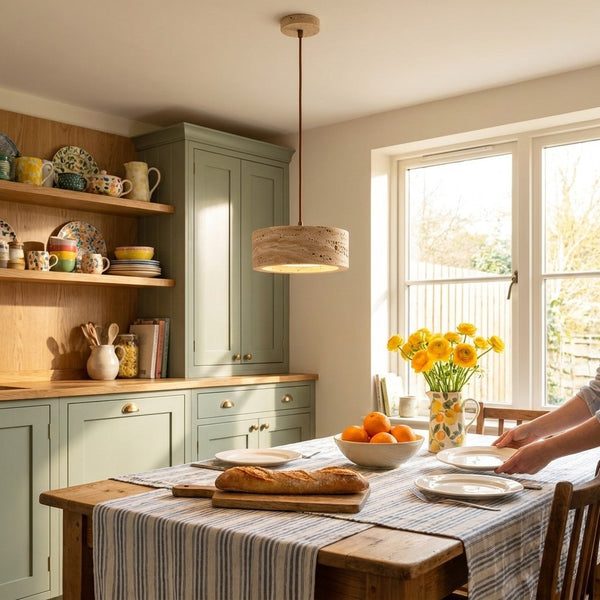
Rattan, travertine, wood or metal: find the pendant that will give your bedroom soft light and real character.
Discover our pendant lights5. At what height to hang a bedroom pendant
The basic rule is the same as in the rest of the house: where people walk, keep at least 2.10 m between the floor and the lowest point of the light. Our article on pendant light height room by room covers every case.
| Position | Recommended height | With a 2.50 m ceiling |
|---|---|---|
| Centre of the bedroom, walkway | Bottom of the light at 2.10 m minimum | About 40 cm for cable and light |
| Above the bed | Bottom of the light at least 1 m above the mattress | About 1.60 to 1.70 m from the floor |
| Bedside pendant | 50 to 70 cm above the bedside table | Bottom at around 1.10 to 1.30 m from the floor |
| Attic bedroom | 2.10 m under the highest part only | Wall lights under the slopes |
Under the roof, the pendant only goes where the height allows; elsewhere, switch to wall lights. Our guide to lighting an attic bedroom details these solutions.
6. What output for a bedroom pendant
For the general light in a bedroom, allow about 75 to 100 lumens per m², all sources combined. The pendant provides the largest share, with bedside and ambient light making up the rest.

| Bedroom size | Recommended total | Pendant's share | LED bulb equivalent |
|---|---|---|---|
| 9 to 10 m² | 700 to 1,000 lm | 500 to 800 lm | One 5 to 8 W bulb |
| 12 to 14 m² | 900 to 1,400 lm | 700 to 1,000 lm | One 7 to 10 W bulb |
| 15 to 20 m² | 1,200 to 2,000 lm | 900 to 1,400 lm | One 9 to 13 W bulb, or several |
A woven fibre or stone pendant filters part of the light: aim for the top of the range, especially with a dimmer.
7. Colour temperature and bulb
In a bedroom, warm white is a must: 2,700 K for a soft atmosphere, 3,000 K if the room also serves as a study or dressing room. Above that, the light becomes more stimulating, which does not help you wind down for sleep. Our article light and sleep explains why.
For an openwork pendant, the bulb matters too: if it is too strong, it casts harsh shadows on the ceiling. Our guidelines are in which bulb for a rattan, bamboo or paper pendant.

8. What size of pendant to choose
Add the length and width of the bedroom in metres and multiply by 6 to 8: you get an indicative diameter in centimetres for a pendant that lights the room. Our article what size of light to choose details these rules of proportion.
| Bedroom | Calculation | Indicative diameter |
|---|---|---|
| 3 m x 3 m (9 m²) | 6 x 6 to 8 | 35 to 50 cm |
| 3.5 m x 4 m (14 m²) | 7.5 x 6 to 8 | 45 to 60 cm |
| 4 m x 5 m (20 m²) | 9 x 6 to 8 | 55 to 70 cm |
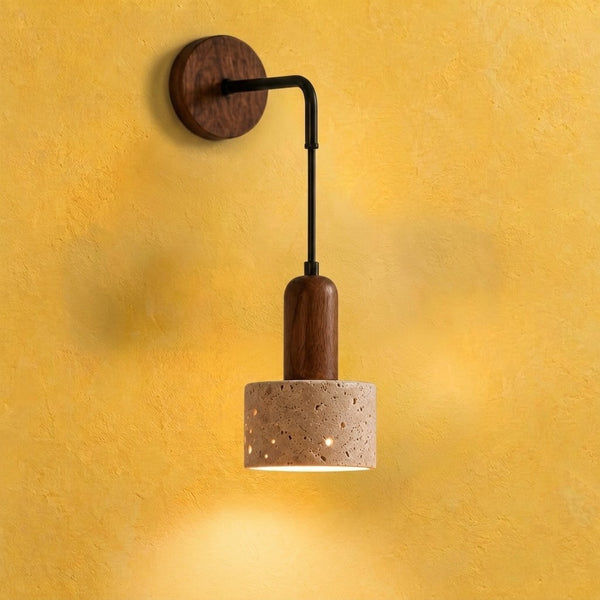
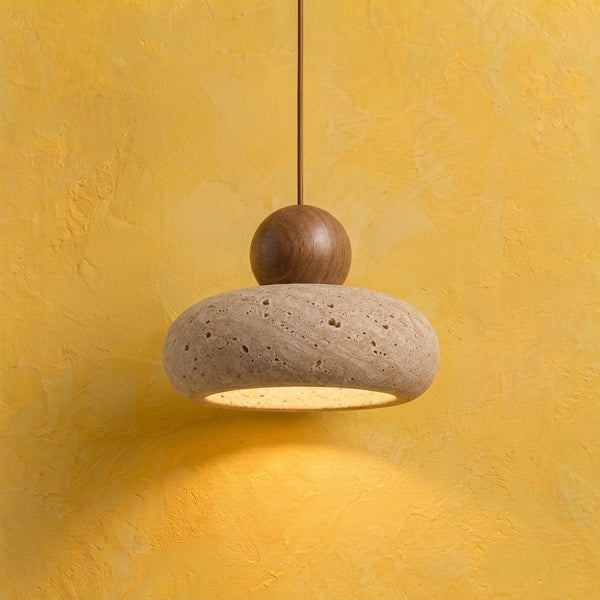
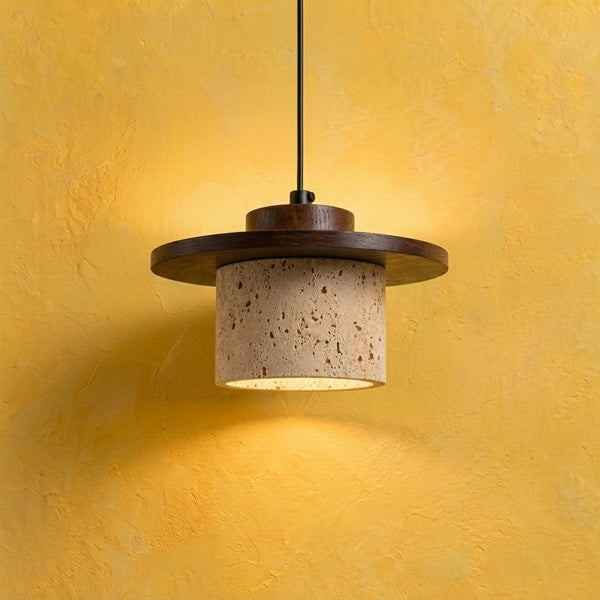
An openwork pendant looks lighter than its diameter suggests: you can choose it a little bigger. Conversely, a small mineral pendant, such as our Japanese wabi-sabi style travertine pendant, works better as a pair above the bedside tables or in a small bedroom.
9. The pendant in a small bedroom
In a 9 m² bedroom, choose something with little vertical bulk (short dome, semi-flush ceiling light), a pale or openwork material that does not close in the space, and leave reading to the bedside wall lights.

A woven ceiling light, such as our 30 cm woven bamboo ceiling light, brings the texture of a pendant without taking up height. For the bedside, our guide to the bedside wall light gives the height and spacing.
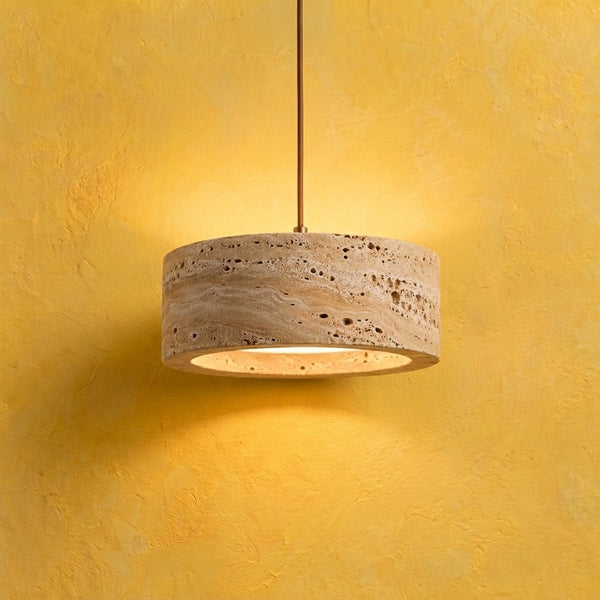
Travertine, marble, natural stone: a mineral pendant for a calm and warm bedroom.
See our stone and travertine lights10. Not being dazzled when lying down
A bedroom pendant is looked at from the bed, head on the pillow: a bulb visible from below then becomes dazzling.
Choose a light that hides the source from below, or an opal bulb. Install a dimmer to go down to 20 or 30 % in the evening: our article on the pendant with remote control and dimmer presents solutions with no building work. Finally, two-way switching between the door and the bed saves you getting up to switch off.
11. In short
One pendant is enough in most bedrooms, placed above the free space rather than in the geometric centre. Above the bed, keep 1 m above the mattress and hide the source. In walkways, the bottom stays 2.10 m from the floor. Allow 75 to 100 lumens per m² in total, a warm white of 2,700 to 3,000 K, and a diameter equal to the sum of the room's sides multiplied by 6 to 8.
Frequently asked questions
What output for a bedroom pendant?
For a 12 to 14 m² bedroom, a pendant of 700 to 1,000 lumens is enough, roughly a 7 to 10 W LED bulb.
Can you hang a pendant above the bed?
Yes, with a light, firmly fixed fitting, at least 1 m above the mattress, and a source hidden from below. A slight offset towards the foot of the bed avoids light in your eyes.
At what height should a pendant hang in a bedroom?
In a walkway, the bottom of the light must be at least 2.10 m from the floor. With a 2.50 m ceiling, that leaves about 40 cm for the cable and the light.
How many pendants in a bedroom?
Just one in most bedrooms. A second is added in a long master suite, or two small ones on either side of the bed as bedside lamps.
What size of pendant for a 12 m² bedroom?
For a 3 m by 4 m bedroom, add 3 and 4, then multiply by 6 to 8: a diameter of about 40 to 55 cm. An openwork pendant can be a little larger.
What colour of light for a bedroom?
A warm white of 2,700 K, or 3,000 K if it also serves as a study or dressing room.
Should the pendant be centred in the bedroom?
Not necessarily. It is better placed above the area where you get dressed and tidy up, often between the foot of the bed and the wardrobe.
Pendant or ceiling light in a small bedroom?
With a ceiling of 2.50 m or less, a ceiling light or a very short pendant leaves more space. Above the bed, where nobody walks, a pendant remains possible.
Our lights for your home
Stone, wood, metal, rattan: real materials. Free delivery across the UK, returns within 90 days.
 -8 %
Travertine pendant light for living room, Japanese wabi-sabi, stone Ø 15 cm
£141.00
 -21 %
Travertine and wood pendant light for living room and dining room, Ø 20 cm
£141.00
 -25 %
Yellow travertine pendant light for living room, natural stone Ø 20 cm
£154.00
 3-light pendant light for living room, black metal, vintage, E27 fitting
£73.00
Worth a read ensuite
All guides → Pendant lights
Globe pendant light and globe chandelier: materials, diameters and clusters
8 min read →
 Pendant lights
Beige pendant light and beige chandelier: sand, linen, rattan or travertine
7 min read →
 Pendant lights
Dining room ceiling light: low ceiling, moved table, the right choices
9 min read →