




Dining room ceiling light: low ceiling, moved table, the right choices
 By the Alméa team
9 min read
Sommaire
A ceiling light is often the right answer for a dining room when a pendant is not: low ceiling, a table that changes position, a room that also serves as a living room or study. This guide helps you choose between a ceiling light and a pendant, then find the right size, output and accompanying lights so the table stays well lit.
A low pendant above the table is an excellent solution when the table stays put and the ceiling allows it. In many homes, these two conditions are not met.
Contents
- When to choose a ceiling light
- Ceiling light or pendant: the comparison
- Low ceiling: the ceiling light as the solution
- Moved table or multi-purpose room
- What size of ceiling light
- How many lumens and which colour temperature
- Shapes and materials that work
- Adding light at table level
- The semi-flush ceiling light, the compromise
- Installing or replacing the light
- In short
- Frequently asked questions
1. Dining room ceiling light: when to choose one
A ceiling light is the obvious choice in four situations:
- The ceiling is low, under 2.40 m, and a pendant would overwhelm the room.
- The table changes position or size: extension leaves, a table pushed against the wall day to day, a room rearranged for parties.
- The dining room is also a walkway, between kitchen and living room, where people move around the table.
- The room has several uses: meals, homework, working from home, games, where even light works better.
If none of these situations apply to you, the pendant remains the most dramatic choice: our guide to the dining room chandelier gives diameters and heights above the table.
2. Ceiling light or pendant: the comparison

| Criterion | Ceiling light | Pendant |
|---|---|---|
| Ceiling height | All ceilings, ideal under 2.40 m | Preferably 2.50 m or more |
| Table position | Any | Must be fixed and centred |
| Light | Broad and even | Concentrated on the table |
| Atmosphere | More neutral | More intimate and dramatic |
| Moving around | No obstruction | Gets in the way if the table is moved |
| Glare | Low, source far from the eyes | Watch out if hung too high |
To look at the question for every room in the house, our article wall light or pendant, room by room completes this table.
3. Low ceiling: the ceiling light as the solution
With a 2.30 m ceiling, a pendant above the table hangs about 75 cm above the tabletop: it then takes up half of the free height and visually cuts the room in two. As soon as you stand up, you brush against it.
A flush ceiling light, on the other hand, takes up only 5 to 15 cm. It frees up all the height. Choose a wide, slim model rather than a thick globe, in a colour close to that of the ceiling so it blends into the surface. Our article on wall lights and low ceilings gives more tips.
4. Moved table or multi-purpose room
A pendant is set to the table: if the table moves, the pendant ends up above empty space or an armchair. It is one of the most common reasons for choosing a ceiling light in the dining room. It lights the whole dining area, whatever the position or length of the table, extension leaves included.
In an open-plan room, it also provides general light for the whole space, while the kitchen and living room have their own sources. Our guide to lighting a kitchen open to the living room shows how to divide up these areas.
Another option if the table only moves a little: keep a pendant and shift it with an offset cable, as explained in our article on the offset chandelier.
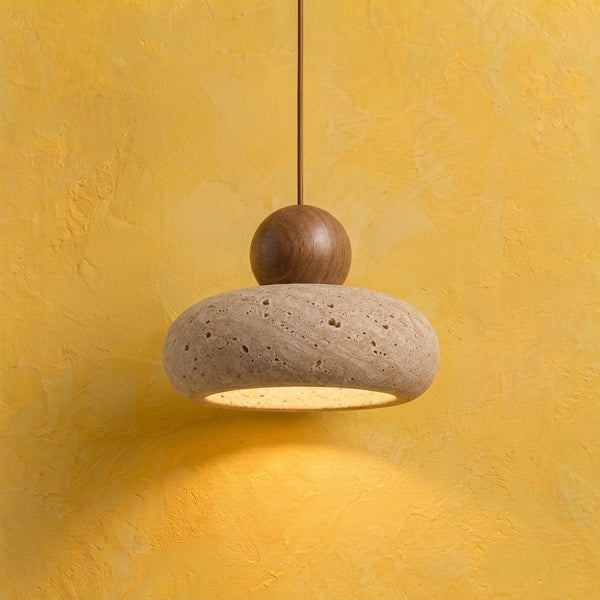
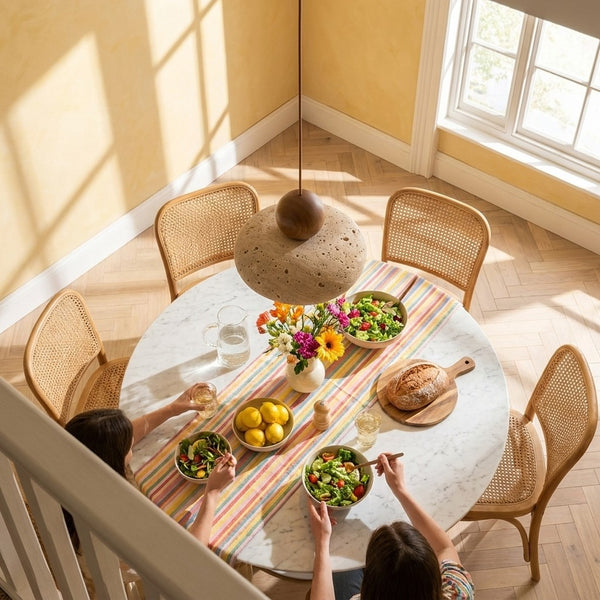
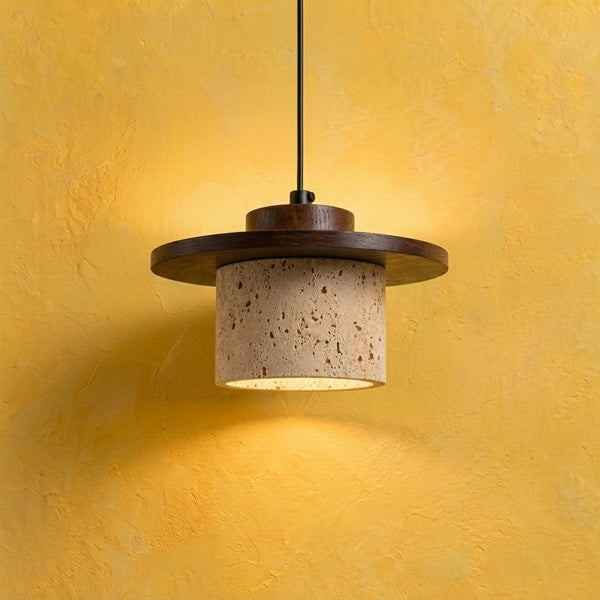
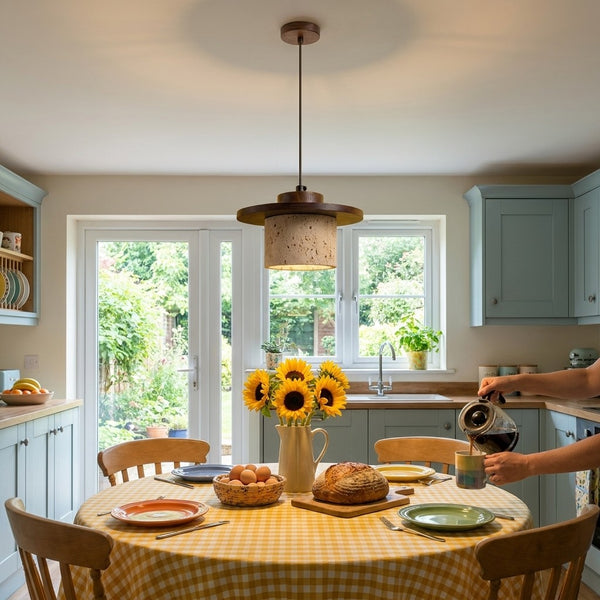
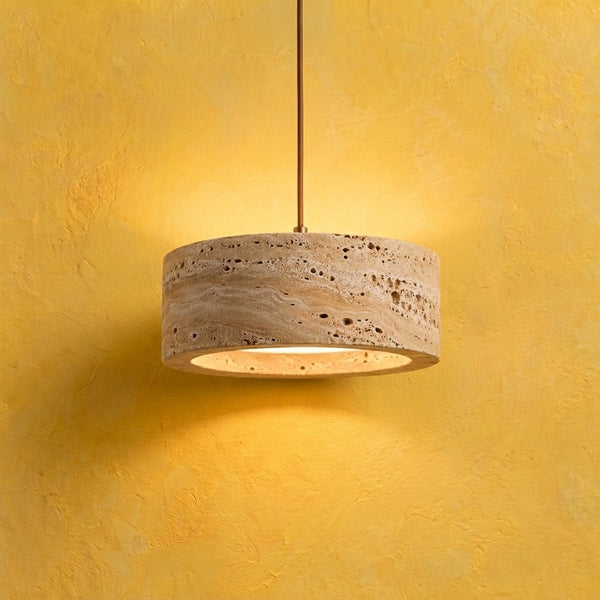
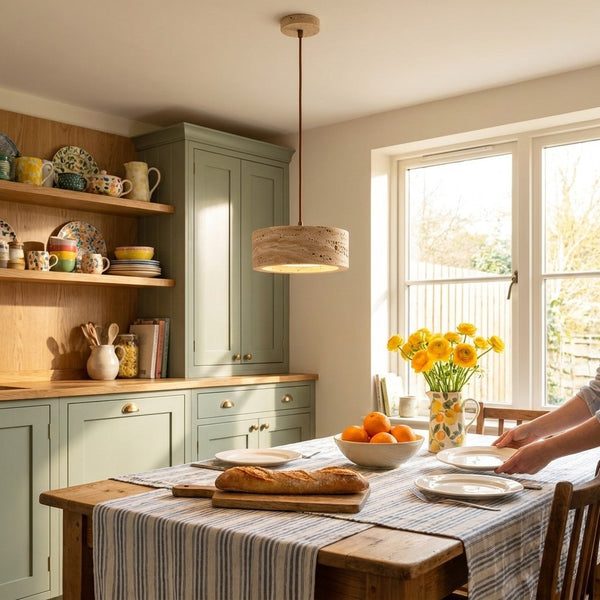
Your ceiling and table allow a pendant? Discover models in travertine, rattan, wood or metal to dress the dining room.
Discover our pendant lights5. What size of ceiling light
For a ceiling light that lights the whole room, add the length and width in metres, then multiply by 6 to 8: you get an indicative diameter in centimetres. If the ceiling light is centred on the table, it can also follow the table: about half its width.
| Dining room | Indicative diameter | Number of ceiling lights |
|---|---|---|
| Dining nook, under 8 m² | 30 to 40 cm | 1 |
| 10 to 14 m² | 40 to 55 cm | 1 |
| 15 to 20 m² | 50 to 70 cm | 1 large or 2 medium |
| Long room, table of 2.20 m or more | 2 of 35 to 45 cm | 2, aligned on the axis of the table |
For a small dining nook, a compact ceiling light such as our 30 cm woven bamboo ceiling light adds texture without taking up height. The rules of proportion are detailed in our guide to lighting a dining nook.
6. How many lumens and which colour temperature
On its own, a ceiling light has to light both the room and the table. Allow about 100 to 150 lumens per m² for a dining room lit only from the ceiling, a little less if wall lights add to it.

| Area | Ceiling light alone | Ceiling light with wall lights |
|---|---|---|
| 8 m² | 800 to 1,200 lm | 600 to 900 lm |
| 12 m² | 1,200 to 1,800 lm | 900 to 1,300 lm |
| 16 m² | 1,600 to 2,400 lm | 1,200 to 1,800 lm |
For colour, a warm white of 2,700 to 3,000 K shows off food and faces. To keep the colours of food true, aim for a CRI of 90 or more. And since a powerful ceiling light can quickly feel cold and flat, a dimmer changes everything: full light for homework, low light for dinner. Our guide to the LED pendant and LED ceiling light helps you check compatibility.
7. Shapes and materials that work
The dining room ceiling light has nothing in common with the frosted glass disc of old any more. Natural materials give it real decorative presence:
- Rattan and woven bamboo: warm, they cast soft shadows. Our guide to the rattan, wicker or straw ceiling light compares them.
- Wood: ideal if the table itself is wooden; see our wooden ceiling light guide.
- Opal glass: an even light with no glare.
- Metal: more graphic, for a contemporary or industrial interior.

8. Adding light at table level
The only weakness of a ceiling light is that its light comes from high up: it lights the room well, the intimacy of the table a little less. You make up for it with lower light:
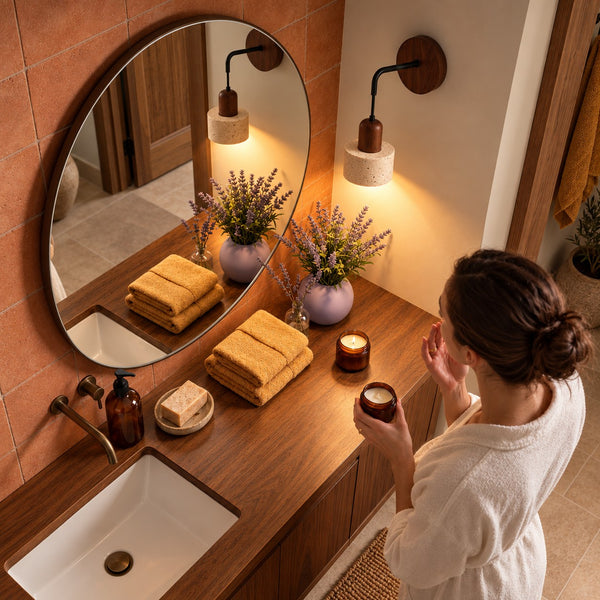
- Wall lights on either side of a sideboard or along the wall by the table, at around 1.60 to 1.80 m from the floor. Our guide to the dining room wall light gives the spacing.
- A table lamp on the sideboard, for warm light at eye level.
- Candles on the table for dinners, which never get in the way.
In the evening, dim the ceiling light and switch on the wall lights: the dining room goes from a functional room to a room for entertaining.
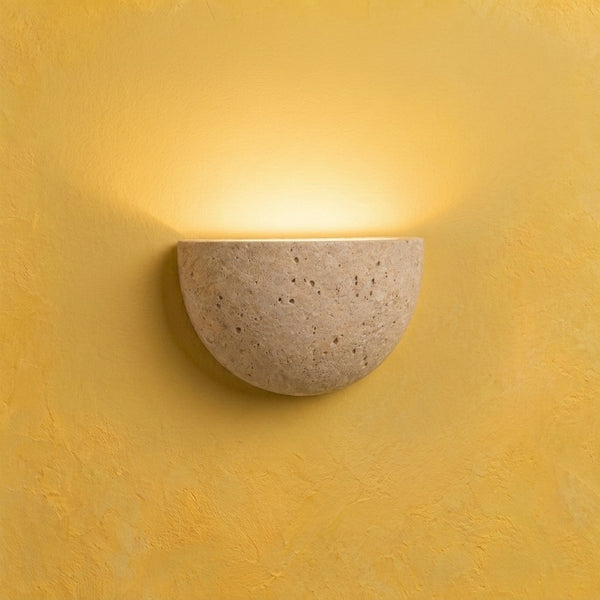
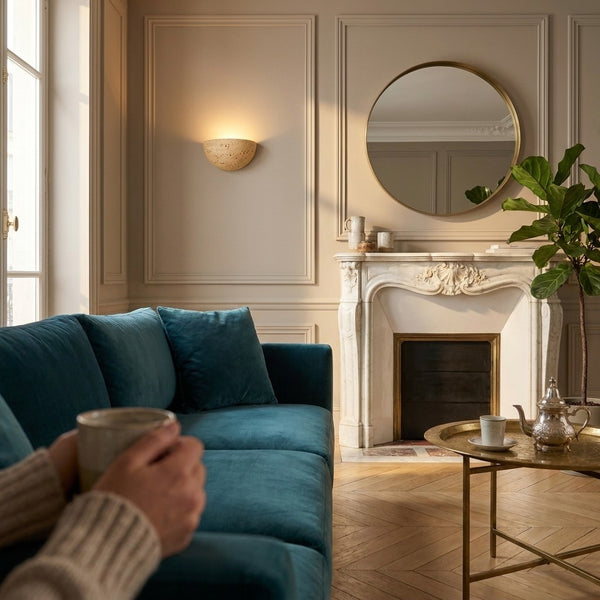
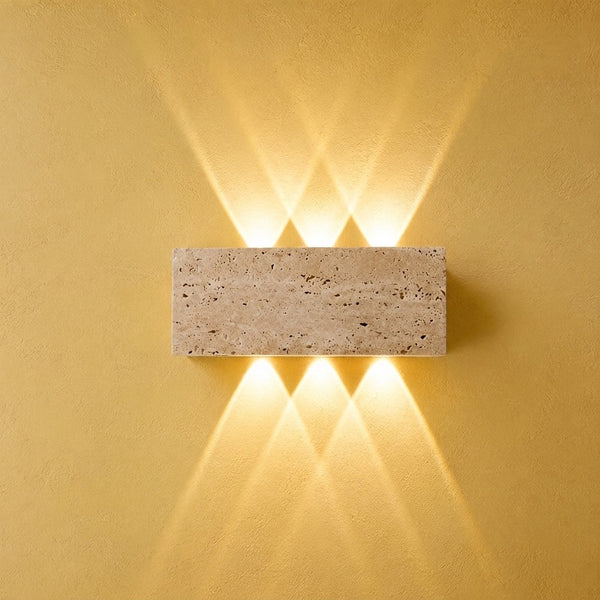
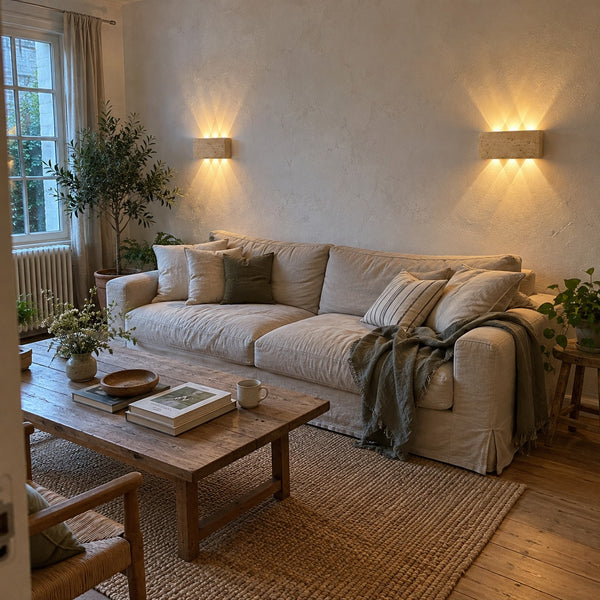
A pair of wall lights is enough to warm up a dining room lit from the ceiling.
See our wall lights9. The semi-flush ceiling light, the compromise
Between the flush ceiling light and the pendant, the semi-flush ceiling light drops 15 to 35 cm below the ceiling. It has more presence than a flat model while keeping 2.10 m of headroom under a 2.50 m ceiling. It is often the most balanced choice when the table moves but you want a light that gets noticed. Our guide to the living room ceiling light details these different profiles, which also apply to the dining room.

10. Installing or replacing the light
Replacing a pendant with a ceiling light is done on the same light point, ideally with a ceiling connection box. Check that the ceiling light's mounting plate covers the original hole, and that the weight of the light suits the ceiling. The full method is in replacing a ceiling light with a pendant, or vice versa.
11. In short
A ceiling light is the right choice for a dining room with a low ceiling, a table that moves or a room with several uses. Diameter equal to the sum of the room's sides multiplied by 6 to 8, 100 to 150 lumens per m² if it lights alone, warm white and a dimmer. Add wall lights or a lamp at eye level to recover the intimacy of a pendant.
Frequently asked questions
Ceiling light or pendant for a dining room?
The pendant if the table is fixed and the ceiling is 2.50 m or higher. The ceiling light if the ceiling is low, the table moves or the room also serves as a walkway or study.
What size of ceiling light for a dining room?
Add the length and width of the room in metres and multiply by 6 to 8. For a room of 3.5 m by 4 m, that gives a diameter of 45 to 60 cm.
How many lumens to light a dining room?
About 100 to 150 lumens per m² if the ceiling light works alone, or 1,200 to 1,800 lumens for 12 m². A little less if wall lights add to it.
How do you light a dining room with a low ceiling?
With a flat, wide ceiling light in a colour close to the ceiling, complemented by wall lights. A pendant quickly gets in the way under 2.40 m.
How do you light a table that is not under the light point?
Either with a ceiling light that lights the whole area, or a pendant moved with an offset cable and a ceiling hook, or wall lights on the wall closest to the table.
Which colour temperature for a dining room?
A warm white of 2,700 to 3,000 K, which shows off food and faces. Pair it with a CRI of 90 or more for accurate colours.
Can you have two ceiling lights in a dining room?
Yes, in a long room or above a large table. Align them on the axis of the table and choose two identical models of 35 to 45 cm.
Is a ceiling light enough for a dining room?
It is enough to light the room, but the light comes from above. One or two wall lights or a lamp on the sideboard bring the softness that dinners need.
Our lights for your home
Stone, wood, metal, rattan: real materials. Free delivery across the UK, returns within 90 days.
 -8 %
Travertine pendant light for living room, Japanese wabi-sabi, stone Ø 15 cm
£141.00
 -21 %
Travertine and wood pendant light for living room and dining room, Ø 20 cm
£141.00
 -25 %
Yellow travertine pendant light for living room, natural stone Ø 20 cm
£154.00
 3-light pendant light for living room, black metal, vintage, E27 fitting
£73.00
 Pendant lights
 Pendant lights
 Room by room