



Bathroom lighting: the complete guide, room by room
 By the Alméa team
13 min read
Sommaire
Choosing bathroom lighting is not about choosing one object, it is about organising three or four lights that work together: the ceiling, the mirror, the mood, sometimes the shower. This complete guide gives you the method room by room, from the small cloakroom with a hand basin to the large family bathroom.
The bathroom is the room where we ask the most of light: shaving or putting on make-up without shadows at 7 in the morning, taking a relaxing bath in the evening, finding your way at night without being dazzled. It is also the only room where water and electricity sit a few centimetres apart, which calls for precise rules.
Contents
- Plan the whole room before choosing a light
- Zones, IP, Class II: safety in 5 minutes
- How much light in a bathroom
- The ceiling light: general light
- Mirror lighting: the light that matters most
- Wall lights: support and mood
- Pendant and chandelier in the bathroom
- Above the shower and the bath
- The small cloakroom and the hand basin
- Room by room: from the 3 m² shower room to the large bathroom
- The windowless bathroom
- Materials and humidity: stone, wood, metal, rattan
- Switches, dimmer and night light
- In short
- Frequently asked questions
 Our favourite
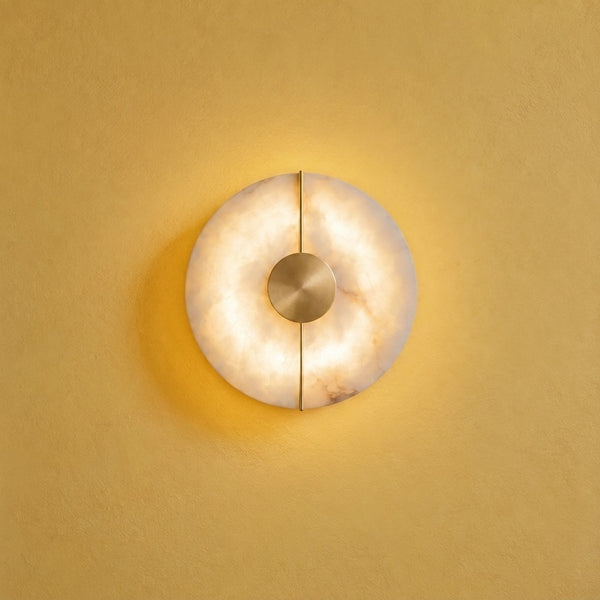
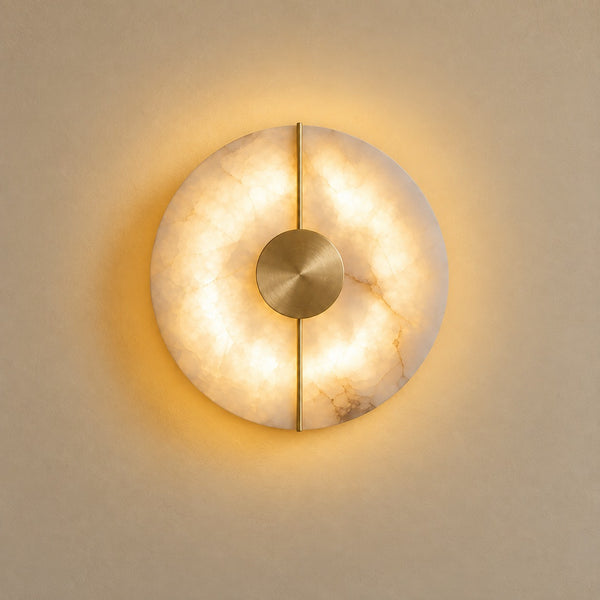
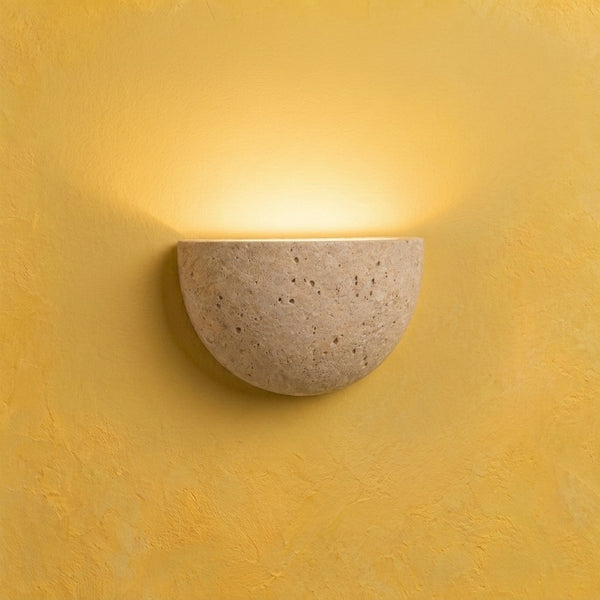
Marble wall light for bedroom, natural stone, alabaster white
£110.00
1. Plan the whole room before choosing a bathroom light
In most bathrooms, the mistake is not the wrong light, it is the single light. One point in the middle of the ceiling lights the floor and the top of your head, but leaves your face in shadow in front of the mirror.
The right approach follows the principle of the three layers of light in a well-lit room, adapted to the bathroom:
- General light: ceiling light, recessed spotlights or a pendant outside the zones, for moving around and cleaning.
- Task light: the mirror, lit from the front or the sides.
- Mood light: a soft wall light or a lit niche for an evening bath.
- Night light, optional: low-level guide lighting for trips at night.
Before buying, sketch the room freehand, mark the shower or bath, the basin, the mirror and the door, then your light points.
2. Zones, IP, Class II: safety in 5 minutes
The wiring regulations (BS 7671) divide the bathroom into zones around the bath and the shower. Each zone sets the level of protection against water and the type of fitting allowed. Our article on bathroom zones explained simply covers the special cases; here is the short version.

| Zone | Where | Minimum protection | Possible lights |
|---|---|---|---|
| Zone 0 | Inside the bath or shower tray | IPX7, safety extra-low voltage | Submersible lighting designed for this use |
| Zone 1 | Above the shower or bath, up to 2.25 m from the floor | IPX4 (IPX5 if jets), safety extra-low voltage | 12 V recessed shower spotlights |
| Zone 2 | 60 cm band around zone 1 | IPX4, Class II | Waterproof ceiling or wall light |
| Outside the zones | The rest of the room | IPX1 minimum, IP44 recommended | Ceiling light, wall lights, pendant, illuminated mirror |
The IP rating is shown in the instructions or on the label: it is the second digit that relates to water. Class II, recognisable by the double square symbol, means reinforced insulation with no need for an earth. All the circuits in the room must be protected by a 30 mA RCD.
A point that is often misunderstood: the zones are defined around the bath and the shower, not around the basin. A vanity unit away from the shower is often outside the zones, which leaves plenty of freedom for lighting the mirror.
3. How much light in a bathroom
The usual aim is 200 to 300 lux for the general light in a bathroom, and about 500 lux on the face in front of the mirror. To convert to lumens, multiply the area by the target light level, with a small margin: our article how many lumens per room details this calculation.
| Area | General light | Mirror | Mood |
|---|---|---|---|
| Cloakroom with hand basin, 1 to 2 m² | 300 to 500 lm | Optional, 200 to 300 lm | Not needed |
| Shower room, 3 to 4 m² | 800 to 1,200 lm | 600 to 1,000 lm | 150 to 300 lm |
| Bathroom, 5 to 7 m² | 1,200 to 2,000 lm | 800 to 1,200 lm | 200 to 400 lm |
| Large bathroom, 8 m² and over | 2,000 lm and more, over several points | 1,000 to 1,600 lm (double basin) | 300 to 600 lm |
For colour, a neutral white of 3,000 to 4,000 K at the mirror helps you judge your complexion or make-up; for mood, a warm white of 2,700 to 3,000 K stays softer. Our article on colour temperature: 2,700 K, 3,000 K or 4,000 K helps you decide.
4. The ceiling light: general light
The ceiling light remains the basis of the lighting in most bathrooms. Flush or semi-flush, it does not get in the way, is easy to clean and gives even light. Choose it in IP44 even outside the zones: steam from a hot shower rises to the ceiling and eventually gets into an unprotected light.
Its ideal place is outside the zones, in the middle of the area where you move around, not necessarily in the geometric centre of the room. In a narrow shower room, two small ceiling lights or three spotlights in a line light better than a single central point. For diameter, IP rating and output, everything is in our complete guide to the bathroom ceiling light.
5. Mirror lighting: the light that matters most
The mirror is where a bathroom succeeds or fails. A light placed above your head deepens dark circles and casts the shadow of your forehead over your eyes. The solution: light the face from the front, at its own height.
Two wall lights, one on each side
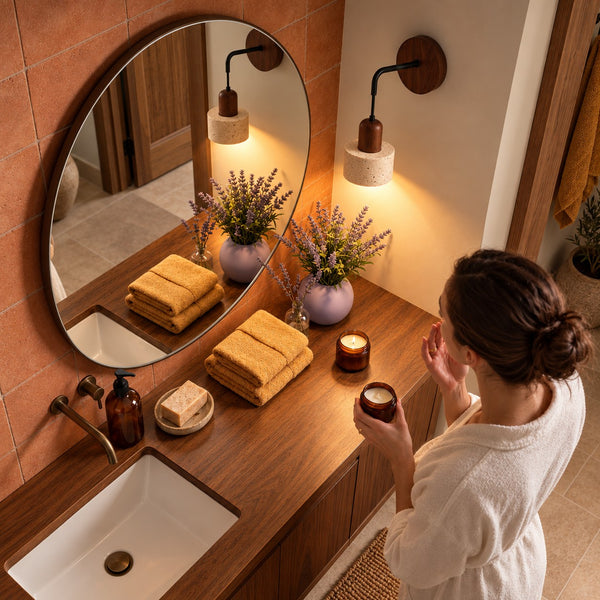
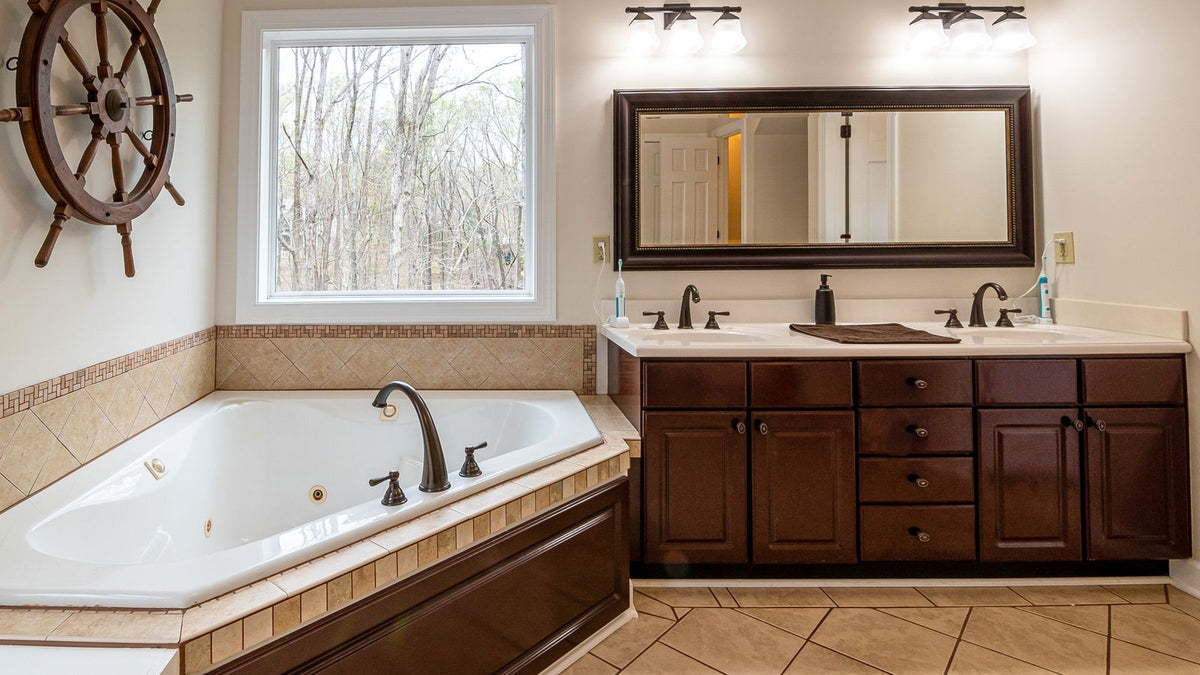
This is the most flattering arrangement: a wall light on each side of the mirror, centre at around 1.60 to 1.70 m from the floor, 70 to 100 cm apart depending on the width of the mirror. Light comes from both sides and erases shadows.
A light bar above the mirror
When there is no room at the sides, a horizontal wall light fitted at around 1.90 to 2.00 m from the floor, at least half as wide as the mirror, works well. The wider it is, the fewer shadows it creates under the eyes.
The illuminated mirror
Handy in a small shower room, it often gives a more decorative than practical light: check its output and its CRI.
The double-basin case and all the details are in our article lighting a bathroom mirror without shadows on the face.
6. Wall lights: support and mood
The wall light is the most versatile tool in the bathroom. At the mirror, it provides the task light. Elsewhere, it brings that soft, side light that transforms the room in the evening: near the bath, outside the zones, or on either side of a window.
For height, spacing and IP ratings, our guide bathroom wall light: choosing and placing it well gives guidelines for each layout. On a tiled wall, drill into the grout lines or use a suitable bit.
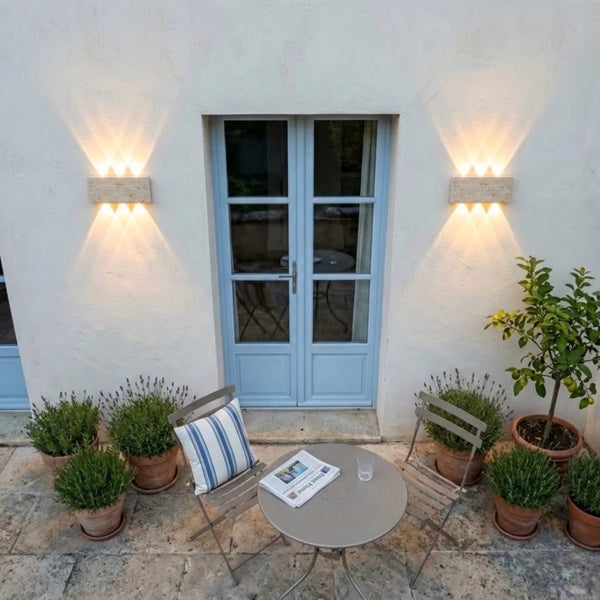
A wall light outside the zones can give the bathroom the warm light of a hotel room. Check the IP rating shown on each product page before choosing where to put it.
Discover our wall lights7. Pendant and chandelier in the bathroom
Yes, you can fit a pendant in a bathroom, on two conditions: that it is outside the zones, or in a zone that allows it with the required IP rating and class, and that the room is high enough and well ventilated. A large bathroom with a 2.70 m ceiling suits a pendant above an open space very well.

Above a bath, you are in zone 1 up to 2.25 m from the floor: a standard pendant that hangs down into this area has no place there. The rules, heights and suitable materials are detailed in our guide to the bathroom chandelier and pendant.
8. Above the shower and the bath
This is the most tightly regulated area. Above the shower, up to 2.25 m from the floor, only safety extra-low voltage lights, with the transformer placed outside the zones, and at least IPX4 are allowed. In practice, IP65 recessed shower spotlights are fitted in a suspended ceiling.
Without a suspended ceiling, a waterproof ceiling light placed outside zone 1 lights the shower over a glass screen. Around the bath, a wall light fitted outside the zones on the opposite wall creates indirect light that is perfect for an evening bath, without ever looking straight at a source once you are lying down.

9. The small cloakroom and the hand basin
The separate toilet is often the most neglected room in the house, even though everyone uses it, guests included. With no shower or bath, it is not subject to the zones; IP44 is still advisable near a hand basin.
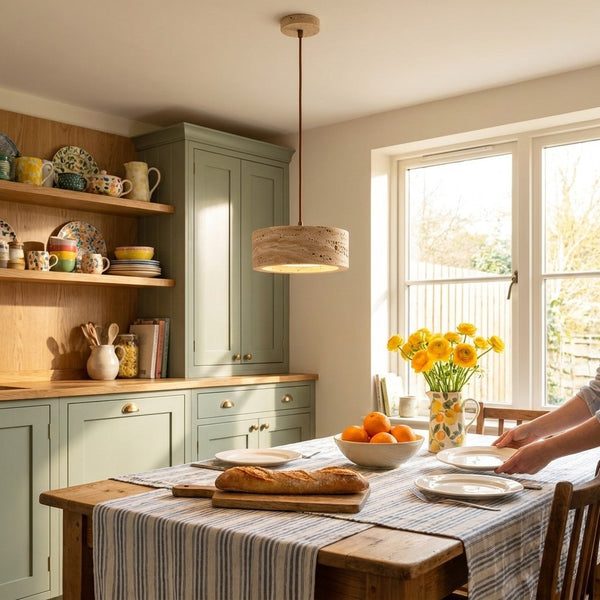
In 1 to 2 m², a single light point is enough. A pendant works wonders here because you do not walk under it as you would in a hallway: it becomes the decorative piece of the room. Our guide to the pendant light for the toilet gives sizes and heights. A presence sensor also stops the light being left on.
10. Room by room: from the 3 m² shower room to the large bathroom
Here are the combinations that work best for each room.
| Room | General light | Mirror | Mood |
|---|---|---|---|
| Cloakroom with hand basin | Small pendant or ceiling light | Wall light above the hand basin | No |
| Shower room of 3 to 4 m² | IP44 ceiling light outside zone 1 | Light bar or illuminated mirror | Lit shower niche |
| Bathroom of 5 to 7 m² | Ceiling light or 3 to 4 spotlights | Two side wall lights | Soft wall light near the bath |
| Large bathroom, double basin | Spread-out spotlights or two ceiling lights | A wall light on each side of each mirror | Pendant outside the zones, mood wall lights |
| Open-plan master suite | Spotlights on a dimmer | Side wall lights | Same family of lights as the bedroom |
The small shower room
In 3 m², the trap is adding too many sources. Two are enough: the ceiling and the mirror. Choose compact lights and a mirror as wide as possible to reflect the light.
The large bathroom
Beyond 8 m², think in zones: basins, bath, shower, walkway. Each zone has its own switch, so you can light only the bath in the evening. In a master suite, repeat the same materials and the same colour temperature as in the bedroom: continuity makes the whole space feel larger.
11. The windowless bathroom
Without daylight, the bathroom depends entirely on its lights. Aim for the top of the lumen ranges, a CRI of 90 or more at the mirror and a neutral white in the morning. Light colours and a large mirror multiply the effect of each source, and effective mechanical ventilation protects the lights. We have devoted a whole guide to the question: lighting a windowless bathroom.
12. Materials and humidity: stone, wood, metal, rattan
Beyond the IP rating, the material determines how long a light lasts in a humid room. Our article lights and humidity goes into detail; here are the main trends.

| Material | Behaviour in humidity | Where to place it |
|---|---|---|
| Glass, glazed ceramic | Excellent, easy to clean | Anywhere, depending on the light's IP rating |
| Painted or treated metal | Good if the finish is high quality | Ceiling, mirror |
| Natural stone, travertine | Fair if the stone is sealed | Outside the zones, ventilated room |
| Wood | Sensitive to changes in humidity | Large ventilated room, away from the shower |
| Rattan, bamboo, fibres | Sensitive, risk of warping | Cloakroom, large and very well ventilated bathroom |
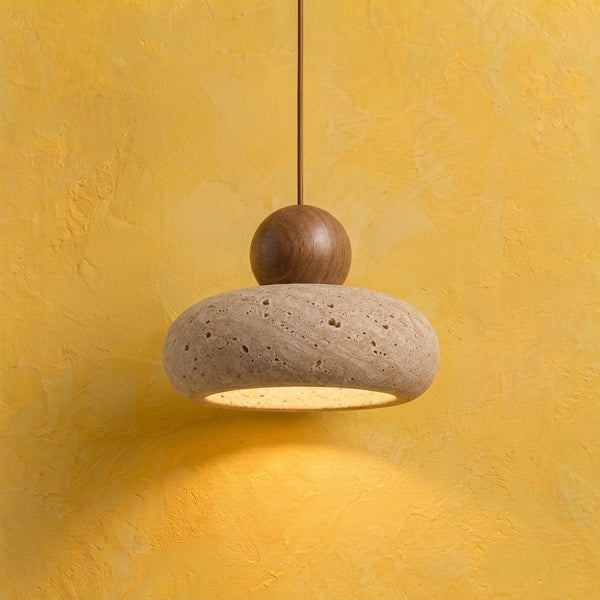
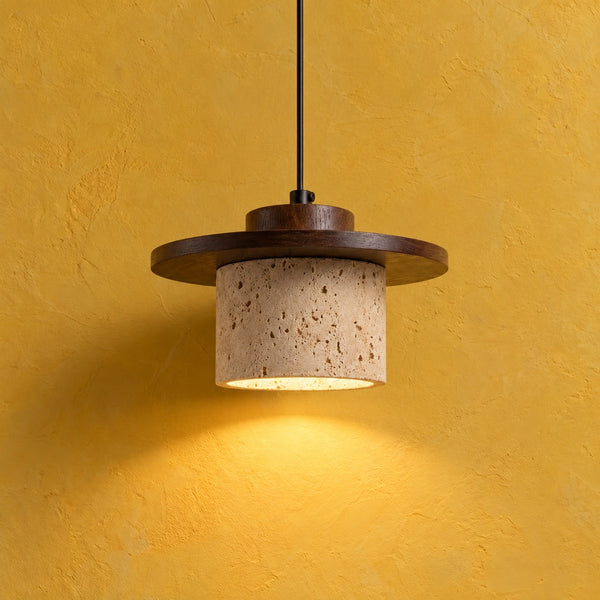
Stone is increasingly popular in bathrooms: it echoes stone basins and worktops and brings to mind a hammam. It has its place outside the zones, in a ventilated room, with a light whose IP rating suits the position. The full picture: a stone light in the bathroom, a good idea?
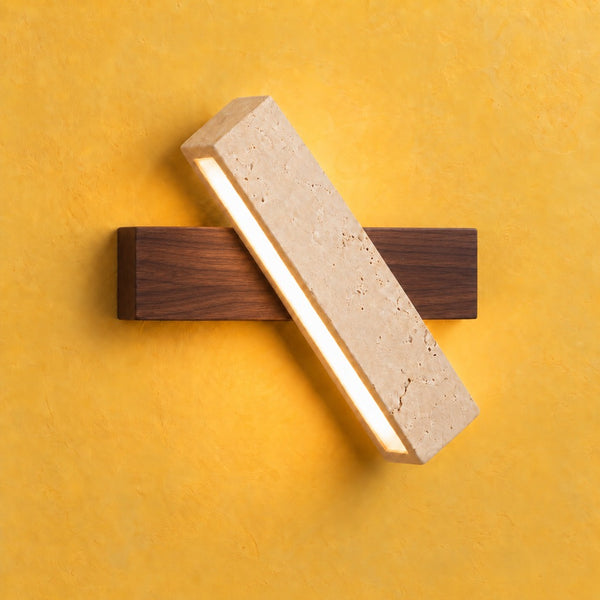
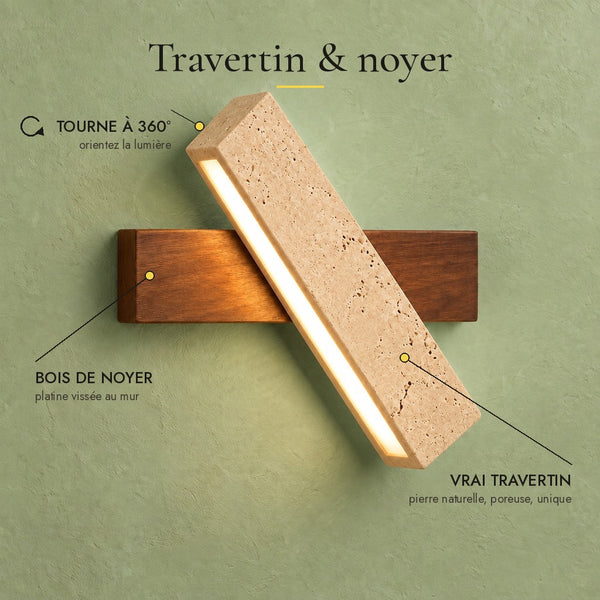
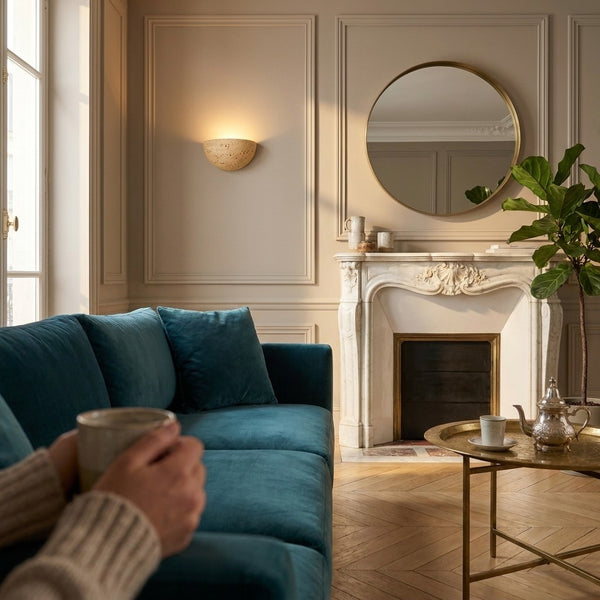
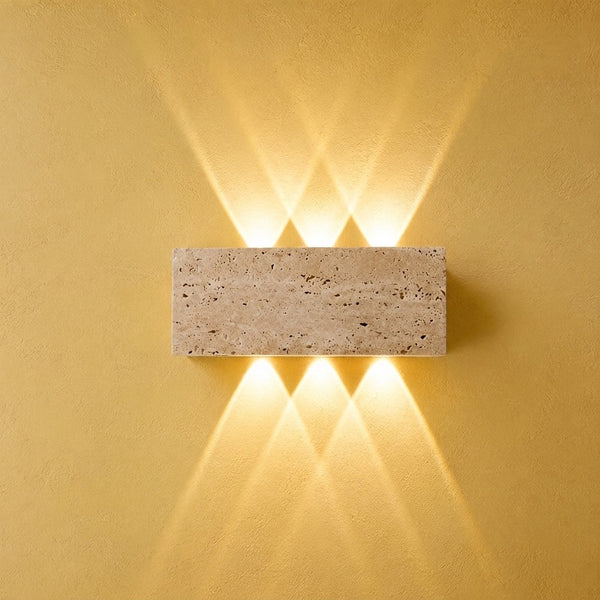
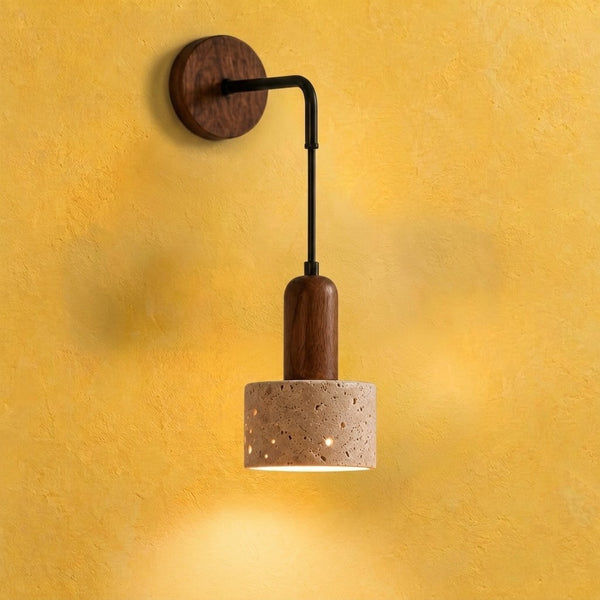
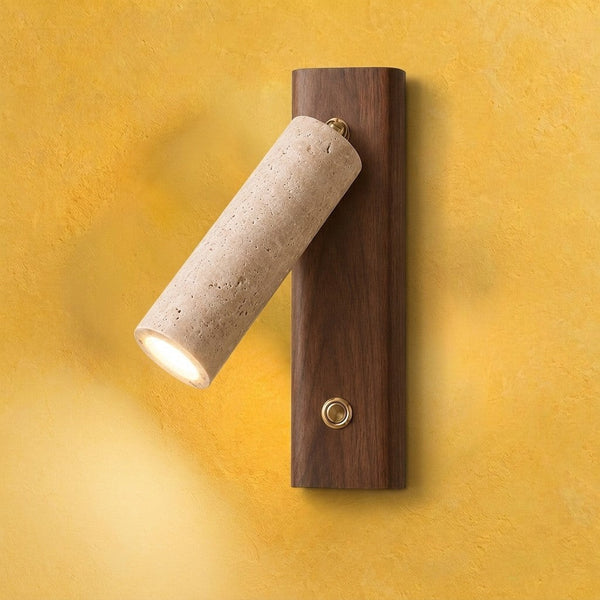
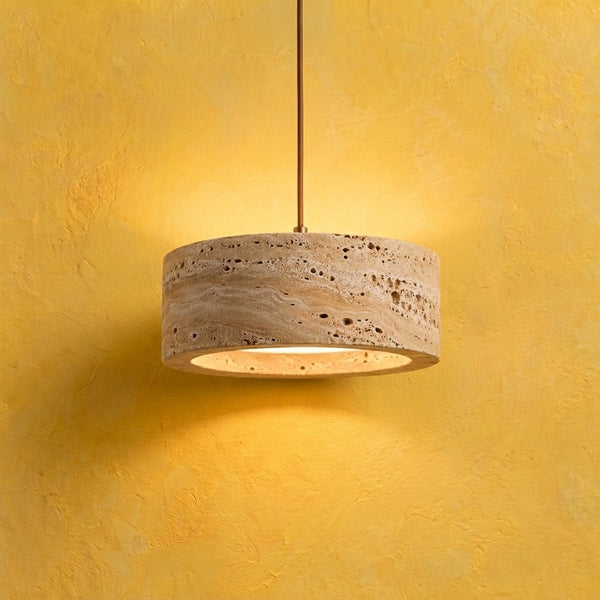
Travertine and natural stone give a spacious bathroom a warm, mineral light, to be placed outside the zones.
See our stone and travertine lights13. Switches, dimmer and night light
Ideally, the general light and the mirror each have their own switch: you do not turn on the whole ceiling to brush your teeth at midnight. For the night, a very soft wall light or low-level guide lighting, around 50 to 100 lumens, avoids harsh glare.
Switches are placed outside zones 0, 1 and 2, often near the door. Our summary of the key wiring rules for your lights covers these points.
14. In short
Successful bathroom lighting always fits into a whole: general light on the ceiling, a mirror lit from the front, a touch of mood and, optionally, a night light. The zones set what goes where, the IP rating and Class II protect against water, and lumens are worked out from the area. From the 1 m² cloakroom to the large bathroom, the method does not change: sketch the room, mark the water points, then plan the lights zone by zone.
Frequently asked questions
Which light to choose for a bathroom?
At the very least, an IP44 ceiling light for general light and mirror lighting, as side wall lights or a light bar. In a larger room, add a mood wall light outside the zones, checking the IP rating and class required for each position.
What IP rating for a bathroom light?
At least IPX4 in zone 2, IPX4 or IPX5 in zone 1 with safety extra-low voltage, IPX7 in zone 0. Outside the zones, IPX1 is formally enough, but IP44 is still recommended because steam reaches the whole ceiling.
Where should lighting go in a bathroom?
General light on the ceiling, in the area where you move around. Mirror lighting at face height, on each side or above. Mood lights near the bath or a niche, respecting the zones.
How many lumens for a bathroom?
Allow 200 to 300 lux of general light, or about 1,200 to 2,000 lumens for 6 m², plus 800 to 1,200 lumens at the mirror. A windowless bathroom needs the top of these ranges.
Can you put a pendant light in a bathroom?
Yes, outside the zones or in a zone that allows it, with the required IP rating and class. Above the bath, up to 2.25 m from the floor, a standard pendant is not allowed.
Which colour temperature for a bathroom?
A neutral white of 3,000 to 4,000 K at the mirror, a warm white of 2,700 to 3,000 K for general and mood light. Avoid cold whites above 4,000 K in a room meant for relaxing.
How high should a bathroom wall light be?
On either side of the mirror, the centre of the wall light sits at around 1.60 to 1.70 m from the floor. Above the mirror, a light bar goes at around 1.90 to 2.00 m, always checking the zones.
Our favourite
Marble wall light for bedroom, natural stone, alabaster white
£110.00 Our lights for your home
Stone, wood, metal, rattan: real materials. Free delivery across the UK, returns within 90 days.
 -35 %
Marble wall light for bedroom, natural stone, alabaster white
£110.00
 -38 %
Natural stone wall light for living room, ambient lighting
£101.00
 -42 %
Travertine wall light for bedroom, natural stone, retro
£129.00
 -49 %
Travertine wall light for living room, natural stone, wabi-sabi
From £82.00
 Inspiration
 Room by room
 Inspiration