




Bedside reading light: arm, beam, height and switch
 By the Alméa team
8 min read
Sommaire
A bedside reading light lights your page, and only your page: a directed beam, an adjustable head and a switch within reach. Swing arm, gooseneck, beam, height and control: this guide helps you choose a bedroom reading wall light that lets you read without waking anyone.
A classic bedside lamp lights everything around it: the bedside table, the wall, the ceiling and often the face of the person next to you. A reading light does the opposite: it focuses light on a precise area, where the book is.
This guide does not cover the bedside mood wall light, which has its own article, but reading light. The two often complement each other very well.
Contents
- Reading light or bedside wall light: the difference
- Arm, gooseneck, adjustable head: the types
- The beam: angle, lumens, kelvins
- How high to fit a reading light
- Reading without disturbing your partner
- The switch: where and which
- Power supply: hard-wired or plug-in
- On the wall or on the headboard
- Pairing a reading light with mood lighting
- Material and style
- In short
- Frequently asked questions
1. Reading light or bedside wall light: the difference
The bedside wall light creates mood lighting around the bed: it lights the wall, it is seen, it is part of the decor. The reading light is a tool: its light is directed, its head adjusts, and it has to light the book without lighting your eyes.
Some wall lights do both, with an adjustable head or two separate sources. If you read in bed regularly, look first at the quality of the beam and how easy it is to adjust, before the style.
2. Arm, gooseneck, adjustable head: the types of reading light

| Type | Adjustment | Ideal for | Limitation |
|---|---|---|---|
| Swing arm | Moves in and out, pivots | Wide bed, reader who changes position | Takes up space, needs a sturdy fixing |
| Flexible gooseneck | Bends in every direction | Precise reading, upholstered headboard | More technical look |
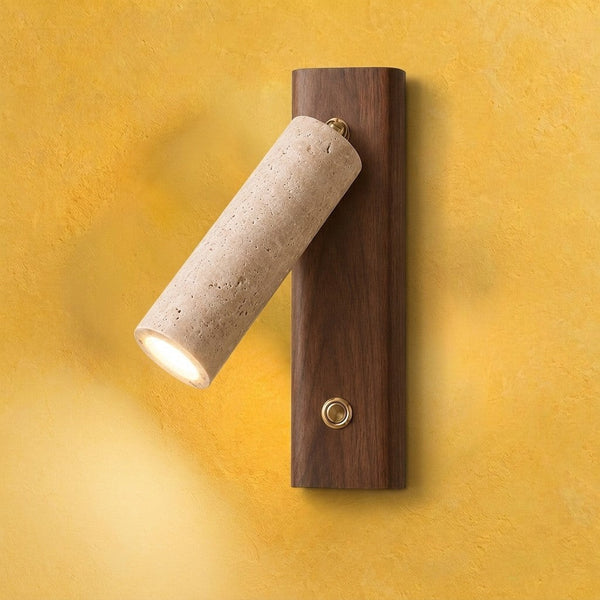
| Adjustable or swivel head | The head turns on its axis | Standard bed, mixed reading and mood use | Limited reach |
| Fixed adjustable spotlight | Ball joint | Integrated headboard, small space | Beam sometimes too wide |
The swing arm is the most comfortable for keen readers. The adjustable head is the best compromise for a bedroom where you read a little every evening. Our article adjustable wall light: when it really makes a difference details the uses.
3. The beam: angle, lumens, kelvins
A good reading light does not have to be powerful: above all, it must be well directed. A narrow beam lights the page without spilling onto the next pillow.
| Criterion | Recommended guide | Why |
|---|---|---|
| Beam angle | 20 to 40 degrees | Wide enough for a book, not for the whole bed |
| Luminous flux | 150 to 300 lumens | Enough at close range, without glare |
| Colour temperature | 2700 to 3000 K | Warm in the evening, comfortable for the eyes |
| CRI | 80 minimum, 90 ideal | Crisp text contrast, true colours |
| Dimmer | Recommended | Lower the intensity before sleeping |
To find out more about the beam, see our guide to the adjustable spotlight wall light, and on evening light, light and sleep.
4. How high to fit a bedside reading light
The head of the reading light should be above and slightly behind your shoulder, so the light falls on the page without you seeing the bulb. For a standard bed, that means a head about 45 to 60 cm above the mattress.
| Height of the top of the mattress | Height of the head from the floor | Sideways offset of the fixing |
|---|---|---|
| Low bed, about 40 cm | 85 to 100 cm | 10 to 20 cm outside the mattress |
| Standard bed, about 55 cm | 100 to 115 cm | 10 to 20 cm outside the mattress |
| High bed or box spring, about 65 cm | 110 to 125 cm | 10 to 20 cm outside the mattress |
With a swing arm, fix it a little further out and higher: the arm will bring the head to the right spot. Bedside heights in general, width and intensity, are covered in lighting a headboard.
Adjustable head, travertine, wood or metal: discover our wall lights, including several reading models for the bedroom.
Discover our wall lights5. Reading without disturbing your partner
This is the whole point of a reading light in a double bed. Three rules are enough: a narrow beam, a head pointing towards the outside of the bed rather than the centre, and a source hidden in a cone or deep shade. Avoid bare bulbs and wide diffusers, which light up the whole headboard. Adjustable intensity also lets you read at the lowest level while the other person falls asleep.
6. The switch: where and which
The control must be within reach while lying down, without sitting up or fumbling around.

- Switch on the head: handy, but you touch the warm lamp and move it.
- Switch on the base or the cable: the most common, to be placed at hand height, about 70 to 90 cm from the floor.
- Touch or dimmer: comfortable for adjusting the light in the evening.
- Two-way switching: switch on from the doorway and off from the bed, to plan in when doing work.
The fitting rules are detailed in switch and socket near a wall light.
7. Power supply: hard-wired or plug-in
A reading light is connected either to a cable outlet in the wall, for a clean finish with no visible wire, or to a socket, with a cable and a built-in switch. The second option avoids building work, especially in a rented home. There are also cordless rechargeable models, handy when no power point is available.

8. On the wall or on the headboard
A reading light is most often fixed to the wall, above or beside the headboard. On a solid wood headboard, you can screw it on directly and run the cable behind. Avoid thin chipboard or upholstered headboards for a swing arm, which acts as a lever. Ideas and fixings in wooden headboard and wall lights.
9. Pairing a reading light with mood lighting
The reading light lights the book, not the bedroom. For a pleasant evening, it goes with a soft light: a mood wall light, a lamp or a bedside pendant. A wall light with two functions, mood and reading, saves space. We discuss this choice in a wall light instead of a bedside lamp. For the reading armchair, see also creating a reading corner.

10. Material and style
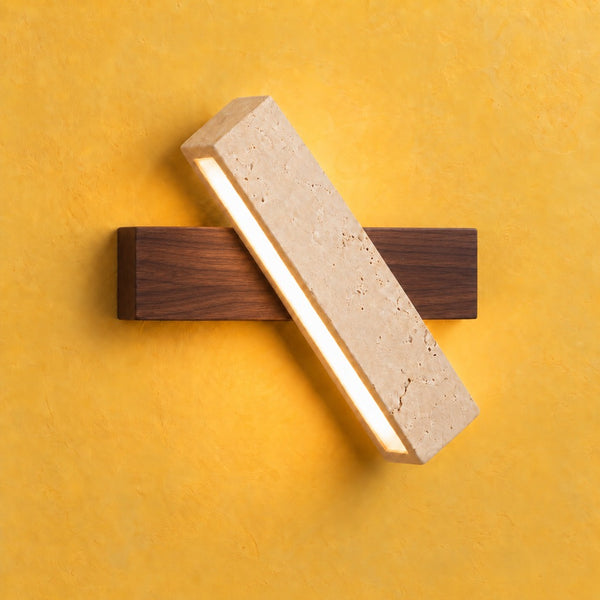
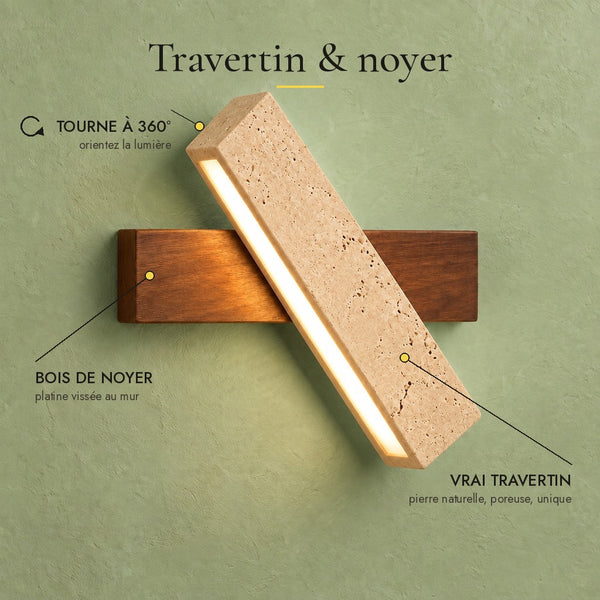
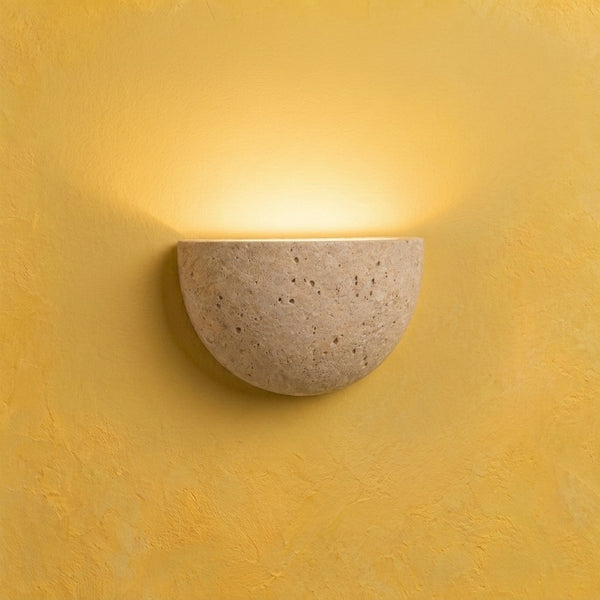
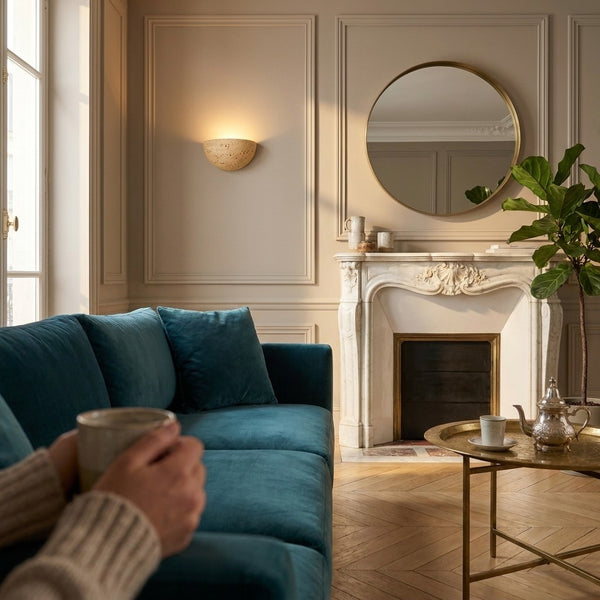
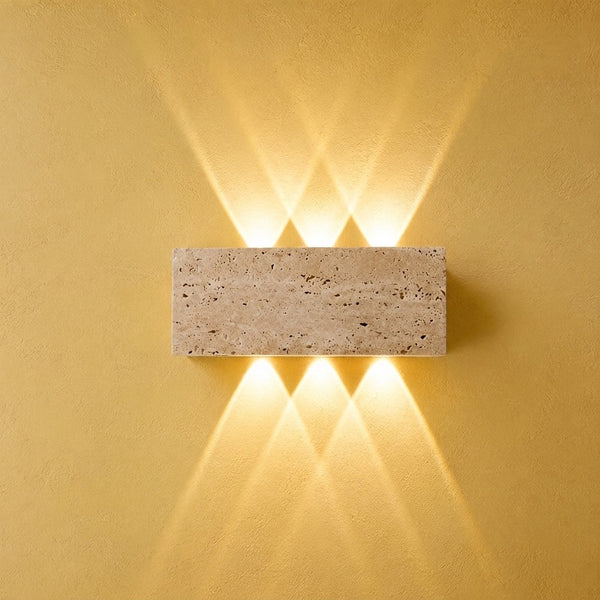
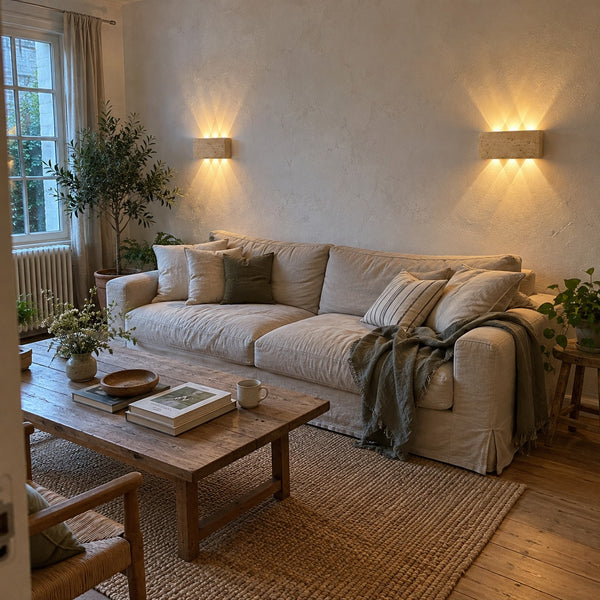
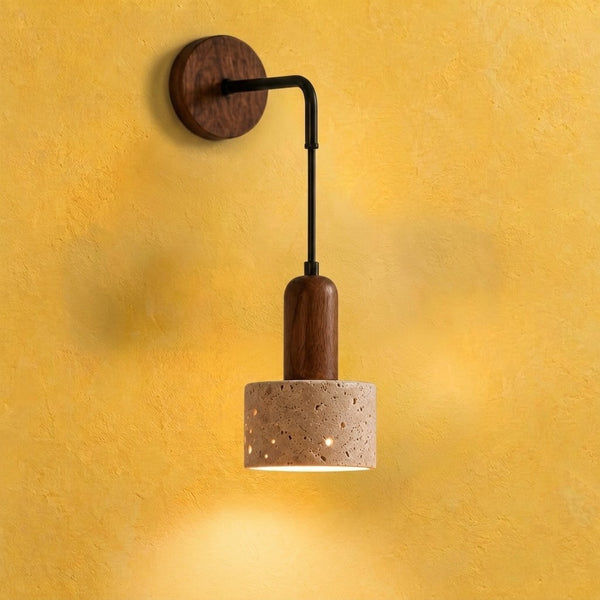
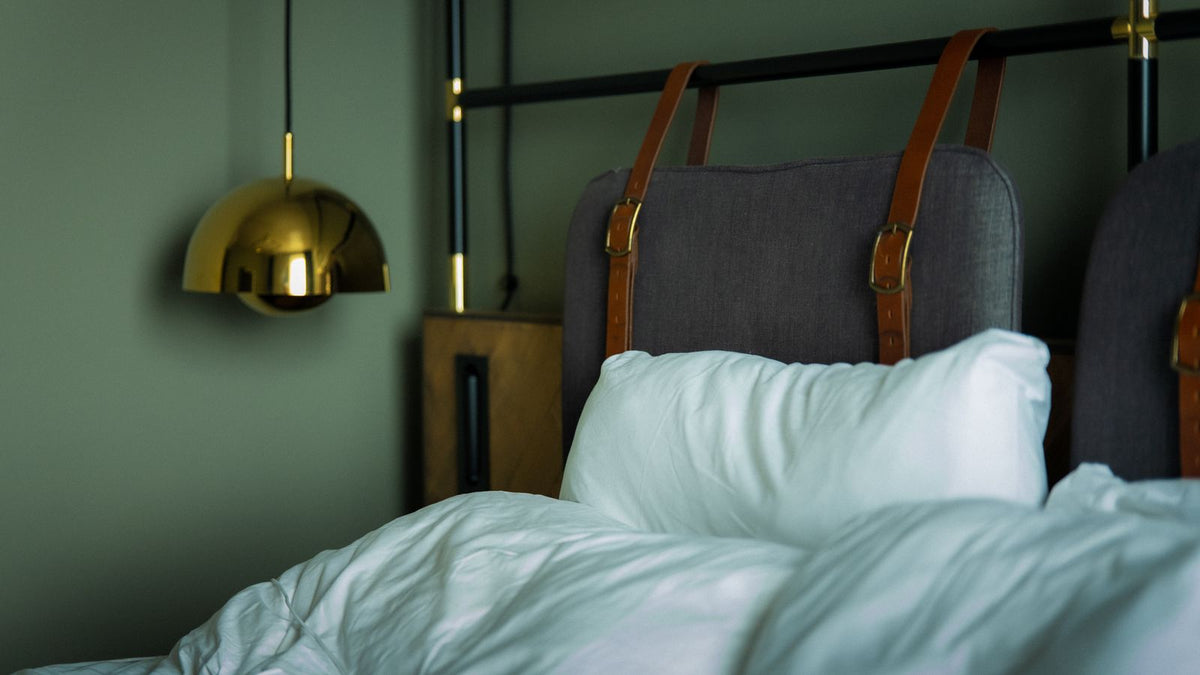
You see a reading light every day: it deserves to look good switched off. Black or white metal gives a workshop feel, wood a Nordic feel, stone paired with wood a natural, calming feel. Our travertine and wood reading wall light with adjustable head and our LED wooden reading wall light with swivel head are two examples.
For a soft, mineral bedroom, browse our travertine wall lights, to pair with a reading light.
See our travertine lights11. In short
A good bedside reading light combines a narrow beam of 20 to 40 degrees, 150 to 300 lumens at 2700 to 3000 K, a head placed 45 to 60 cm above the mattress and a switch within reach. Swing arm for keen readers, adjustable head for mixed use. Add mood lighting, and for the full plan of the room, see our guide to bedroom lighting.
Frequently asked questions
How high should a reading light be fitted above a bed?
The head should be about 45 to 60 cm above the mattress, or 100 to 115 cm from the floor for a standard bed. It should be above and slightly behind your shoulder.
How many lumens for a reading light?
150 to 300 lumens are enough at close range, with a narrow beam. A dimmer lets you adjust it to the book and how tired you are.
Which colour temperature for reading in bed?
2700 to 3000 K: warm enough for the evening, sharp enough for the text. Avoid cold white before sleeping.
How do you read in bed without disturbing the other person?
Choose a reading light with a narrow beam, point the head towards the outside of the bed and lower the intensity. A source hidden in a deep cone avoids glare.
Swing arm or gooseneck: which to choose?
The swing arm offers more reach and comfort for a large bed. The gooseneck is more compact and very precise, handy on a headboard or a small wall.
Can you fit a reading light without building work?
Yes, with a plug-in model fitted with a cable and switch, or with a cordless rechargeable wall light.
Where should the switch of a reading light go?
Within reach while lying down: on the cable, on the base or on the wall, about 70 to 90 cm from the floor. A touch switch or dimmer is very comfortable.
Can you fix a reading light directly to the headboard?
Yes, on a solid wood headboard. Avoid thin or upholstered headboards for a swing arm, which has a lever effect.
Our lights for your home
Stone, wood, metal, rattan: real materials. Free delivery across the UK, returns within 90 days.
 -36 %
Marble wall light for bedroom, natural stone, alabaster white
£110.00
 -38 %
Natural stone wall light for living room, ambient lighting
£101.00
 -42 %
Travertine wall light for bedroom, natural stone, retro
£129.00
 -38 %
Travertine wall light for living room, natural stone, wabi-sabi
From £101.00
 Inspiration
 Room by room
 Room by room