




Living room floor lamp: choosing and placing it well, arc, reading lamp, uplighter
 By the Alméa team
9 min read
Sommaire
A living room floor lamp brings light where the ceiling light cannot reach: beside the sofa, behind an armchair, into a dark corner. Arc, reading lamp, uplighter or shaded model, each family has its use, its right height and its right place. Here is how to choose it, where to put it, and when a wall light does the job better.
Let us say it straight away: Maison Alméa does not sell floor lamps. We offer wall lights and pendant lights. This guide therefore helps you choose a floor lamp completely independently, then shows you honestly when a wall light or pendant meets the same need better.
Contents
- What a living room floor lamp is for
- The main families of floor lamps
- The arc floor lamp
- The reading floor lamp
- The uplighter and indirect light
- What height of floor lamp
- Lumens and colour temperature
- Where to put a floor lamp in the living room
- Floor lamp or wall light: the comparison
- When a wall light does better
- Combining floor lamp, wall lights and pendant
- In short
- Frequently asked questions
1. What a living room floor lamp is for
A living room floor lamp rarely serves as the main lighting. It complements the ceiling light or replaces it in rooms without a central light point. It is used for three jobs: lighting a specific corner (reading, armchair), warming up a dark corner, or bouncing light off the ceiling to light the whole room softly.
That job dictates the family, the height and the output. To place this choice within the whole room, our complete living room lighting plan details the role of each source.
2. The main families of floor lamps

| Family | Light | Ideal use | Watch out for |
|---|---|---|---|
| Arc | Direct, downwards, offset | Above a coffee table or sofa | Floor space, heavy base |
| Reading lamp | Direct, targeted beam, often adjustable | Reading armchair | Lights the room very little |
| Uplighter | Indirect, towards the ceiling | Soft general light | Needs a light-coloured ceiling |
| With a shade | Diffuse, all round | Mood in a corner | The shade must hide the bulb |
3. The arc floor lamp: reach, base and position
The arc floor lamp is the most sought-after for a living room. Its base sits behind or beside the sofa, and its shade floats above the coffee table, like a pendant you never had to wire into the ceiling.
The right measurements
- Reach: between 1.20 m and 2 m depending on the model. Measure the distance between where the base will stand and the centre of the coffee table.
- Height: 1.80 m to 2.20 m at the top of the arc. The bottom of the shade ideally sits between 1.40 and 1.60 m from the floor above a coffee table, so it does not block the view of people sitting down.
- Base: a heavy base (stone, cast iron, concrete) is essential for stability. Allow for the footprint, often 30 to 40 cm square.
In a small room, the arc quickly overwhelms the space: a pendant then does better, see pendant light above a sofa.
4. The reading floor lamp: light for reading
A reading lamp concentrates light on the book without lighting the whole room. It goes next to the armchair, slightly behind your shoulder, on the opposite side to the hand that turns the pages, to avoid the shadow of your hand on the page.
The head is usually between 1.20 m and 1.40 m from the floor. An adjustable or flexible arm lets you change the angle without moving the base. Allow 250 to 400 well-directed lumens: that is enough to read without tiring your eyes. Our guide to creating a reading corner details the full set-up.
5. The uplighter and indirect light
The uplighter casts its light towards the ceiling, which reflects it around the whole room. The result is a soft general light, with no harsh shadows or glare. It is a good solution for lighting a living room without a ceiling light.
Two conditions for it to work: a light-coloured ceiling, ideally white, and a ceiling height of at least 2.40 m. Under a dark or low ceiling, the light is absorbed or forms a patch that is too concentrated. The principle of this reflected light is explained in direct, indirect and grazing light.
6. What height of floor lamp to choose

| Type | Usual overall height | Useful guide |
|---|---|---|
| Reading lamp | 1.30 to 1.60 m | Head at around 1.20 to 1.40 m, behind the shoulder |
| With a shade | 1.50 to 1.70 m | Bottom of the shade at around 1.10 to 1.30 m, bulb hidden when seated |
| Uplighter | 1.70 to 1.90 m | At least 50 cm between the top and the ceiling |
| Arc | 1.80 to 2.20 m | Bottom of the shade at around 1.40 to 1.60 m above the coffee table |
For a shaded model next to the sofa, the most reliable guide is simple: when seated, you should not be able to see the bulb from under the shade.
7. How many lumens and which colour temperature
| Floor lamp use | Recommended output | Temperature |
|---|---|---|
| Mood in a corner | 400 to 800 lm | 2,700 K |
| Reading lamp | 250 to 400 lm, directed | 2,700 to 3,000 K |
| Arc above the coffee table | 600 to 1,000 lm | 2,700 K |
| Uplighter, general lighting | 1,500 to 3,000 lm | 2,700 to 3,000 K |
Keep the same colour temperature as the other lights in the living room, otherwise the room looks disjointed. For the overall calculation, see how many lumens per room and our article on 2,700 K, 3,000 K or 4,000 K.

8. Where to put a floor lamp in the living room
- In a corner: a shaded floor lamp or an uplighter makes the room look bigger by lighting two walls at once.
- Next to the sofa: at the end of the armrest, 20 to 40 cm from the seat, for reading or chatting.
- Behind an armchair: the natural place for a reading lamp.
- Away from walkways: a base in a busy area always ends up getting knocked.
The cable should reach a socket without crossing a walkway. And with a playful cat, a lightweight floor lamp is a real risk, see lights and pets.
9. Floor lamp or wall light: the honest comparison
| Criterion | Floor lamp | Wall light |
|---|---|---|
| Installation | None, plug-in | Hard-wired, or plug-in model |
| Floor space | Takes up 30 to 40 cm | None |
| Mobility | Easy to move | Fixed |
| Stability | Can be knocked over | Out of reach |
| Visible cable | Often on the floor | Concealed, or cable cover on the wall |
| Decorative effect | An object in the room | Dresses the wall, shows off the material |
The floor lamp wins when you rent or move your furniture around often. The wall light wins as soon as floor space, safety or the look of the wall matter.
10. When a wall light does better than a floor lamp
In several situations, a wall light does the same job as a floor lamp, without its drawbacks:

- Small living room: a wall light frees up the floor and the corner of the room.
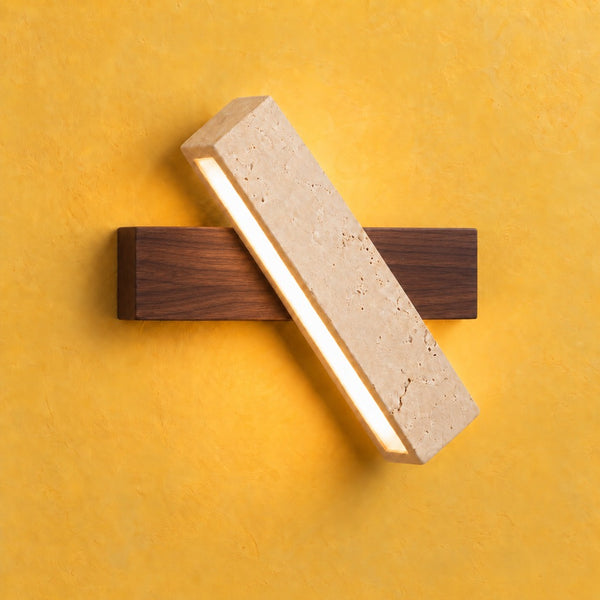
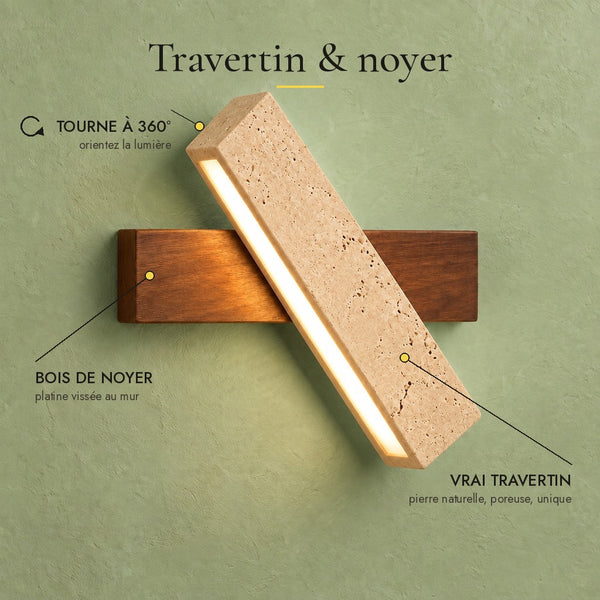
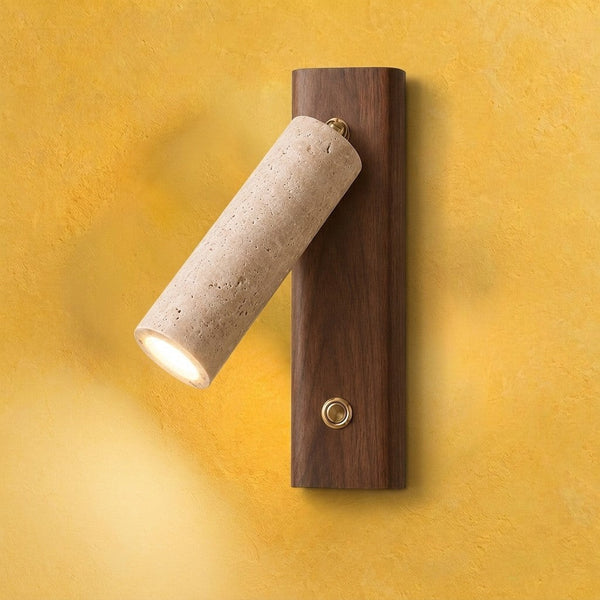
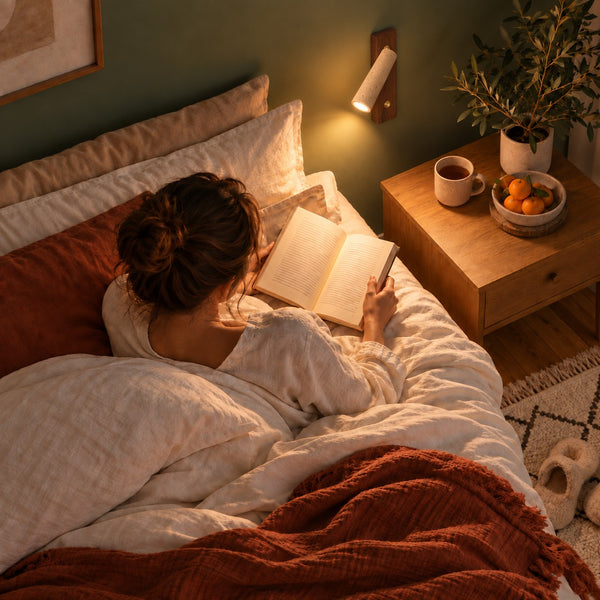
- Reading in an armchair: a wall light with an adjustable head, fitted at around 1.20 to 1.40 m, replaces the reading lamp. See our travertine and wood reading wall light with adjustable head and the guide to the swing arm wall light.
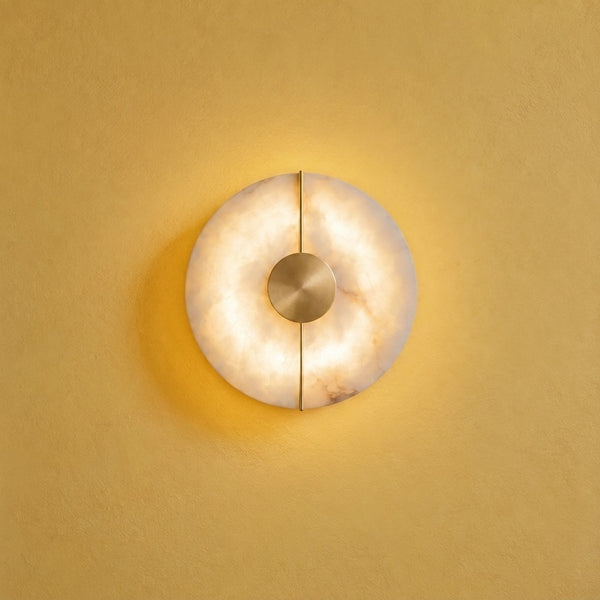
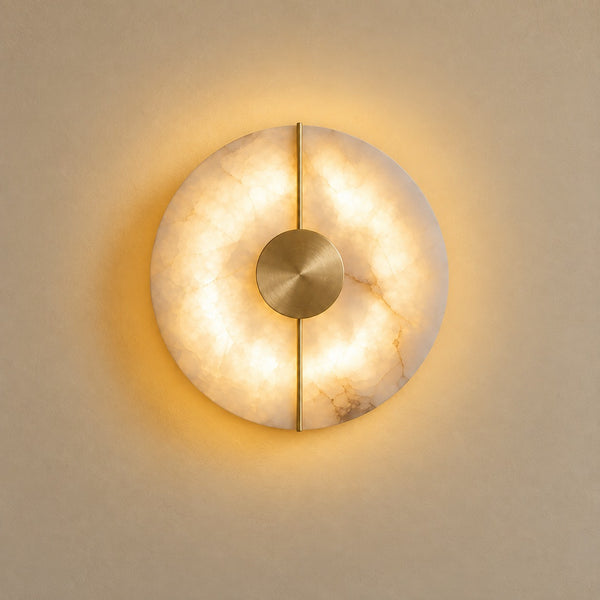
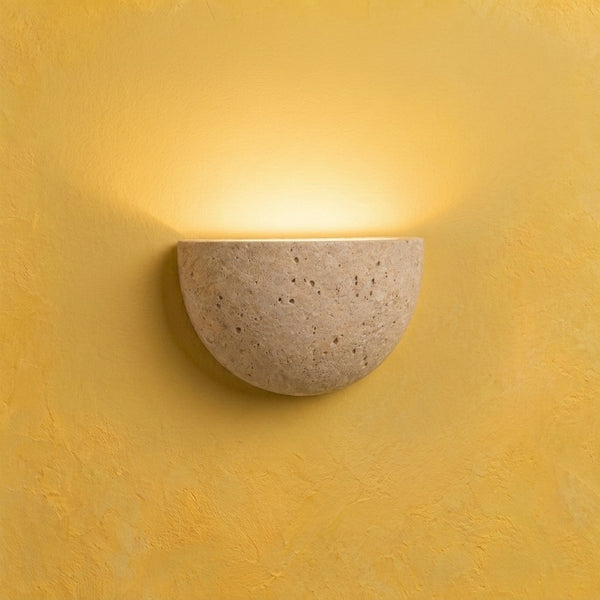
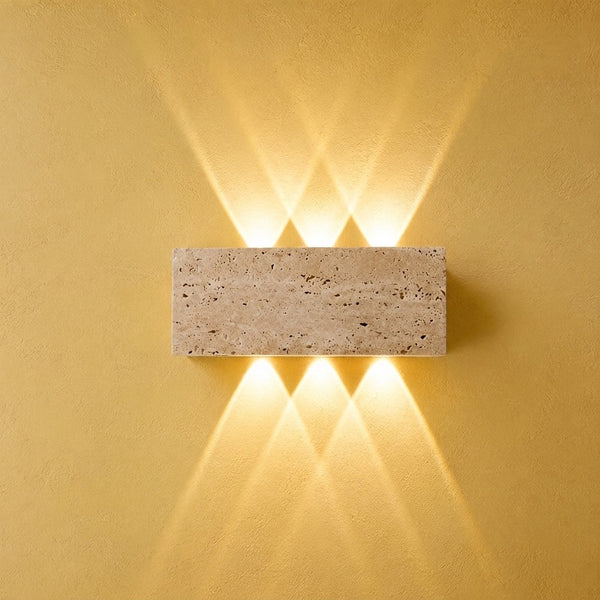
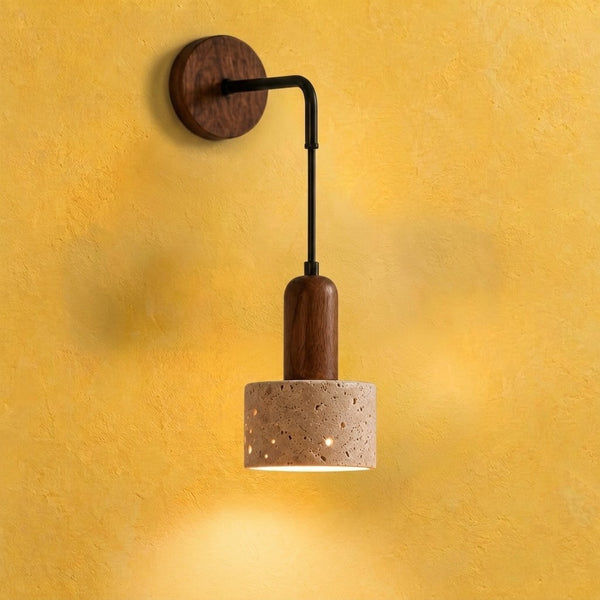
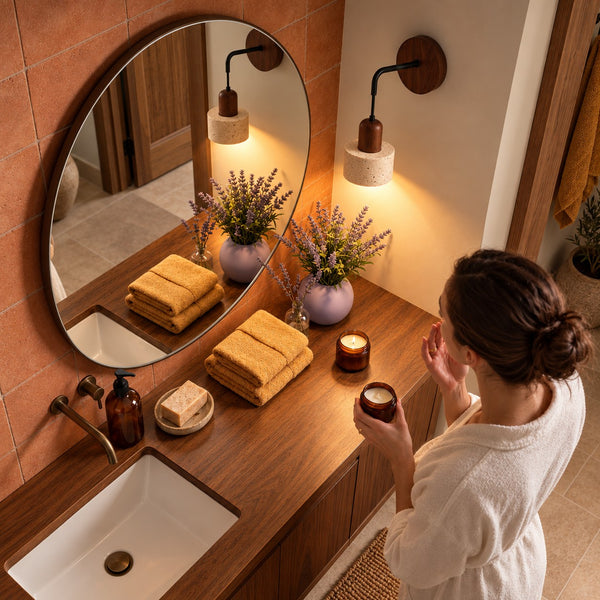
- A wall worth showing off: a natural stone wall light brings out the texture of the wall, which a floor lamp cannot do.
And if you do not want to drill for the cable, there is a halfway solution: the plug-in wall lamp, which fixes to the wall and plugs in like a floor lamp.
Free up your living room floor: our stone, wood or metal wall lights light the armchair as well as the wall.
Discover our wall lights11. Combining floor lamp, wall lights and pendant
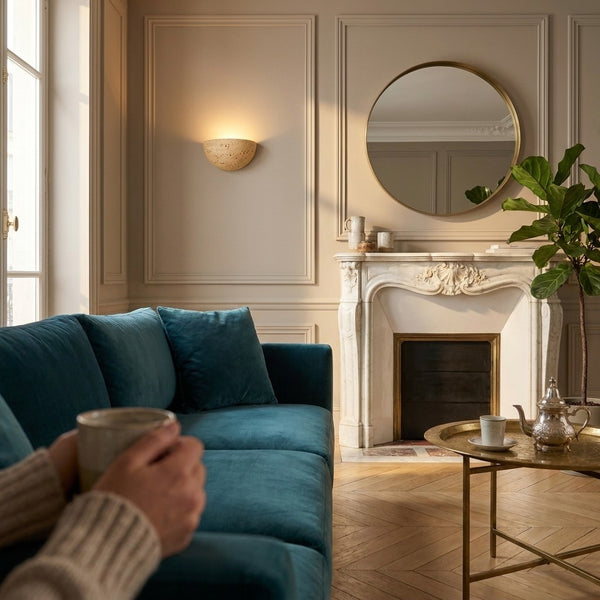
The best-lit living room combines several sources at different heights: a high light (pendant or ceiling light), a mid-height light (wall lights) and a low or targeted light (floor lamp, table lamp). That is the principle of the three layers of light.
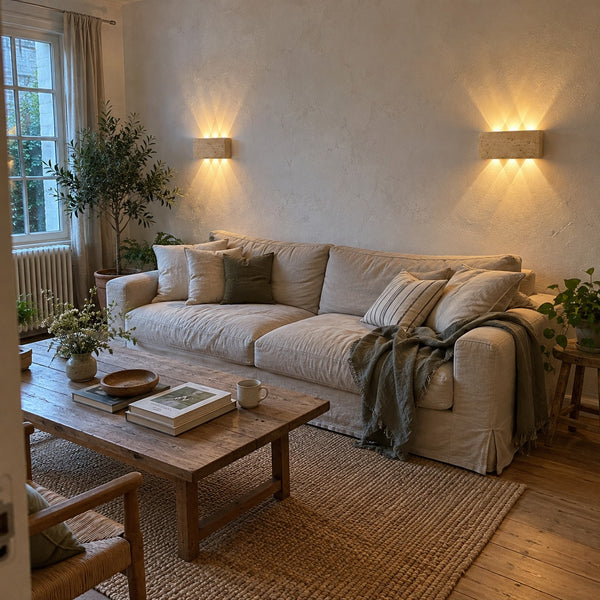
The right split: two wall lights for mood on the main wall, a pendant above the coffee table or dining table, and a floor lamp or reading lamp by the armchair. To work out the number of wall lights, see how many wall lights in a living room.
Above the coffee table or dining table, a pendant is a great alternative to the arc of a floor lamp.
Discover our pendant lights12. In short
Choose your living room floor lamp according to its job: the arc to light the coffee table, the reading lamp for reading, the uplighter for soft general light, the shade to warm up a corner. Respect the heights (bulb hidden when seated, bottom of the arc at around 1.40 to 1.60 m), keep the same temperature as the rest of the living room and keep it away from walkways. When floor space, safety or showing off the wall come first, a wall light or pendant often does better. See also our guide to the living room wall light.
Frequently asked questions
What height for a living room floor lamp?
Allow 1.50 to 1.70 m for a shaded model, 1.70 to 1.90 m for an uplighter and 1.80 to 2.20 m for an arc. The real guide is still the bulb: sitting on the sofa, you should not be able to see it.
Where should an arc floor lamp go?
Put the base behind or beside the sofa, out of the way, and bring the shade over the centre of the coffee table. Measure the reach before buying: it varies from 1.20 to 2 m depending on the model.
How many lumens for a floor lamp?
About 400 to 800 lumens for a mood floor lamp, 250 to 400 directed lumens for a reading lamp and 1,500 to 3,000 lumens for an uplighter meant to light the whole room.
What is the difference between a floor lamp and a reading lamp?
A floor lamp gives off mood or general light. A reading lamp concentrates a beam on the book. Some models do both.
Can a floor lamp replace a ceiling light?
Yes, an uplighter under a light-coloured ceiling can provide the general lighting. In a large living room, add wall lights.
Which colour temperature for a living room floor lamp?
Stay between 2,700 and 3,000 K, like the rest of the living room. 2,700 K gives a warm atmosphere, 3,000 K is better for reading.
Floor lamp or wall light: which to choose?
A floor lamp suits you if you rent or often move your furniture. A wall light is better in a small living room, with children or to show off a wall.
How do you hide a floor lamp cable?
Run it along the skirting board or in self-adhesive trunking painted the colour of the wall, never across a walkway.
Further reading
Our lights for your home
Stone, wood, metal, rattan: real materials. Free delivery across the UK, returns within 90 days.
 -36 %
Marble wall light for bedroom, natural stone, alabaster white
£110.00
 -38 %
Natural stone wall light for living room, ambient lighting
£101.00
 -42 %
Travertine wall light for bedroom, natural stone, retro
£129.00
 -38 %
Travertine wall light for living room, natural stone, wabi-sabi
From £101.00
 Room by room
 Guide pratique
 Guide pratique